Installation · 19 October 2026 · 4 min read
Cable tray support spacing: how far apart should hangers be?
Support spacing decides deflection, safety and the amount of support material. Typical hanger spacing for cable tray and cable ladder, plus the rules at joints, bends and risers.
Written by the Ponggawa technical team
Also available in: Bahasa Indonesia · 简体中文
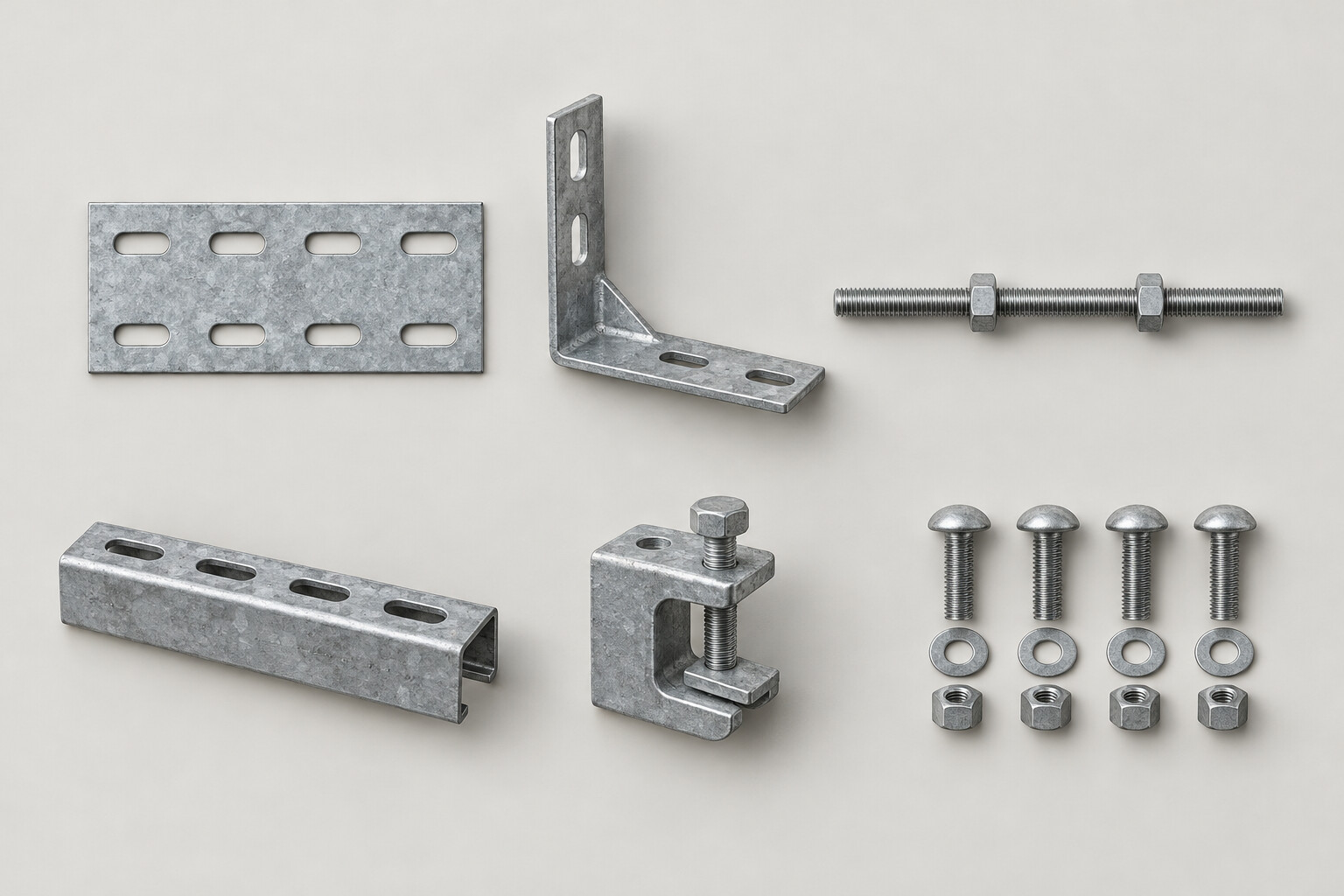
Short answer: for cable tray 50 mm high, supports are usually 1.5 to 2 m apart; for cable tray 100 mm high, 2 to 2.5 m; for cable ladder, 2.5 to 3 m. Place a support within 600 mm of every joint and on both sides of every fitting. The final spacing depends on the weight of the cables and the plate thickness.
In NEMA and IEC terms, support spacing is the span. A NEMA load class combines two values: the number is the support span and the letter is the working load the tray must carry over that span. If your specification states a load class, show the support spacing on your drawings as well, so every bidder works from the same span. Our article on the NEMA VE 1 standard explains how to read those classes.
Why support spacing matters
Deflection increases very quickly as the span gets longer. When the span is too long, the tray sags, the joints start to work like hinges and the cables inside are put under tension. The deflection limit commonly used is 1/250 of the span, for example 10 mm on a span of 2.5 m.
As a reference for capacity, an independent laboratory load test report for cable ladder type W, 1,000 mm wide, 100 mm high and 2.0 mm thick, on a span of 2.5 m, recorded 360 kg exactly at the 10 mm deflection limit. Capacity on your route still depends on the width, rail height, plate thickness and spacing you specify.
Rules of thumb
System | Typical support spacing |
|---|---|
Cable tray H50 | 1.5 to 2 m |
Cable tray H100 | 2 to 2.5 m |
Cable ladder H100 | 2.5 to 3 m |
Heavy-duty cable ladder | Up to 3 m or more, based on calculation |
Use these values for early layouts and budget quantities. Confirm the final spacing against the cable schedule, because cable weight and plate thickness decide the spacing on each route.
Supports at joints, bends and risers
- Install a support within 600 mm of every join set joint.
- Install a support on both sides of every elbow, tee and cross.
- On vertical runs, install a support every 1.5 to 2 m and tie the cables to the rungs or to the tray base.
These rules add support points on top of the regular spacing, so count them separately when you prepare the BOQ. A route with many bends and branches needs noticeably more hanger beams, hanger rods and anchors than a straight run of the same length.
Fewer supports without compromising safety
If you want to reduce the number of supports, increase the rail height or use the stiffer cable ladder type W, rather than simply stretching the distance between hangers. Stretching the spacing on the same tray brings back the deflection problem described above. For long spans on pipe racks and steel structures, also look at heavy-duty cable ladder.
We can help calculate the support requirement from your layout drawings. Send the layout and the cable schedule through our quotation request form, and the quotation lists the supports together with the trays and fittings.
Frequently asked questions
What is the maximum support span for cable ladder?
For cable ladder with a 100 mm rail, the typical support spacing is 2.5 to 3 m. Heavy-duty cable ladder can go up to 3 m or more where the calculation supports it. The final spacing depends on the cable weight and the plate thickness.
What deflection limit is used to set the spacing?
The limit commonly used is 1/250 of the span, which is 10 mm on a span of 2.5 m. For reference, cable ladder type W, 1,000 mm wide, 100 mm high and 2.0 mm thick, carried 360 kg at that 10 mm limit on a 2.5 m span in an independent laboratory test.
How close to a joint or fitting should a support be?
Place a support within 600 mm of every join set joint. Elbows, tees and crosses need a support on both sides. These extra points come on top of the regular spacing.
How far apart should supports be on vertical runs?
On vertical runs, install a support every 1.5 to 2 m. Tie the cables to the rungs of a ladder or to the base of a tray, so the cable weight does not hang from the terminations.