Comparisons · 19 October 2026 · 9 min read
Cable Ladder Type W vs Type U: Side Rail Differences and Selection
Type W cable ladder uses a double-folded side rail that is stiffer than the type U rail. Specify type W where power cables are dense and the support spacing cannot be reduced.
Written by the Ponggawa technical team
Also available in: Bahasa Indonesia
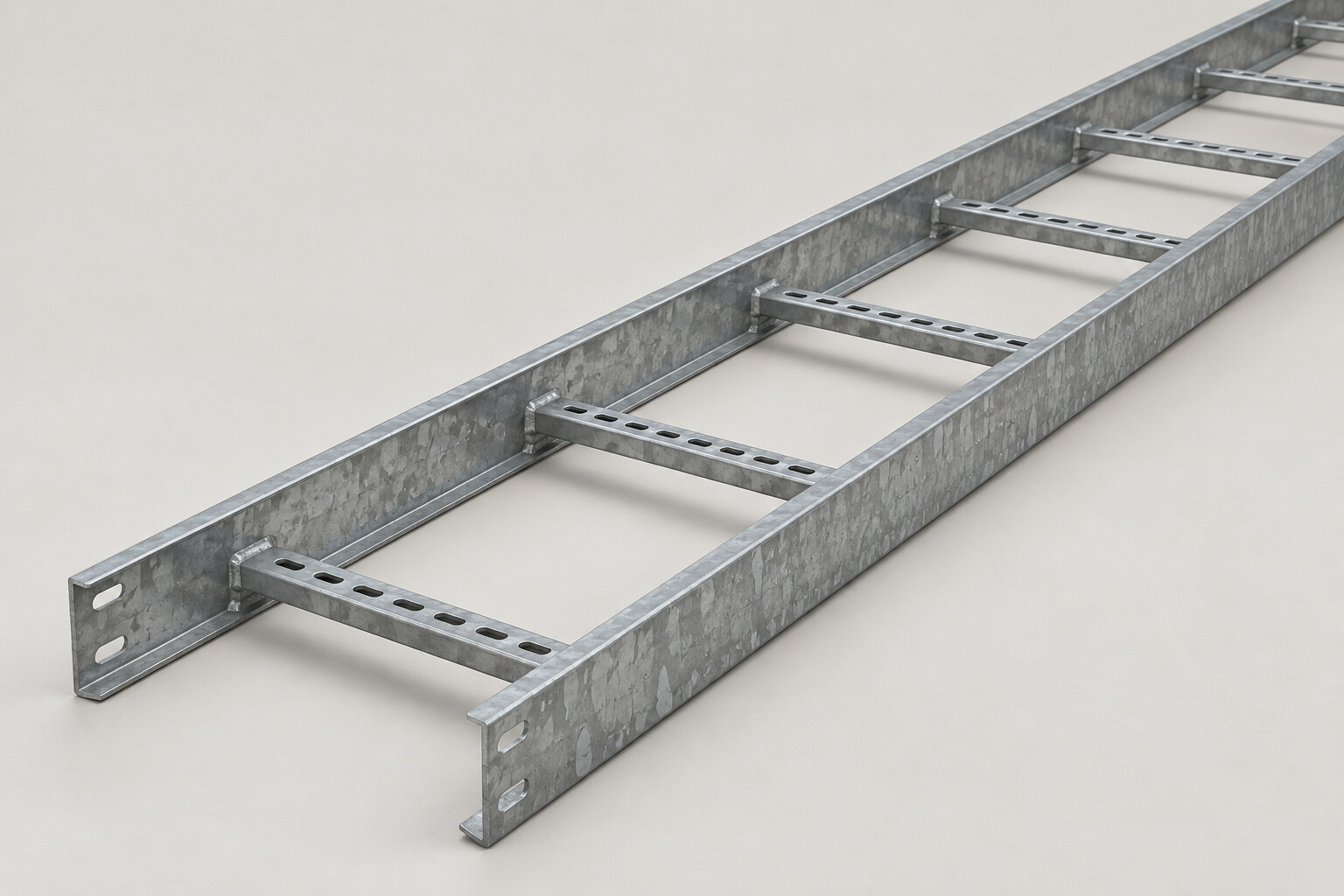
Short answer: type U cable ladder uses a C-profile side rail with an inward lip, while type W cable ladder uses a double-folded W-profile side rail that is stiffer. At the same plate thickness and span, type W deflects less. Type U is sufficient for building and factory routes with closely spaced supports; specify type W where power cables are dense and the support spacing cannot be shortened, for example on a pipe rack.
If you are writing the cable support section of a specification or checking a BOQ for a plant in Indonesia, this is the decision that matters: which runs can stay on type U, and which runs need the stiffer type W rail because the structure fixes the span.
Side rail profile: type U and type W
Both types have the same ladder form: two steel side rails connected by rungs every 300 mm, with a standard length of 3,000 mm per piece. The difference is the cross-section of the side rail, and that cross-section determines how stiff the ladder is under cable load.
Type U cable ladder
Type U uses a C-shaped side rail with a 17 mm inner lip that holds the rungs from the side. The rungs have a U profile of 45 x 20 mm with a row of 10 x 55 mm slots, so cable ties and clamps can be fixed at any point along the rung.
Rail height is available in 50 mm for control and instrumentation cables and 100 mm for power cables. Widths run from 100 to 1,200 mm. This is the type most commonly used for indoor and outdoor routes in commercial buildings, factories and panel rooms.
Type W cable ladder
Type W adds an extra fold to the side rail so that its cross-section resembles the letter W. This fold raises the moment of inertia of the rail without increasing the plate thickness.
Type W is available with a 100 mm rail height and widths from 100 to 1,000 mm. It is used on pipe racks, in power plants and on routes carrying dense power cabling.
Comparison: type U vs type W cable ladder
Aspect | Type U (PGW-LU) | Type W (PGW-LW) |
|---|---|---|
Side rail profile | C with 17 mm inner lip | W, double-folded |
Rail stiffness | Standard | Higher at equal plate thickness |
Rail height | 50 and 100 mm | 100 mm |
Width | 100 to 1,200 mm | 100 to 1,000 mm |
Rung spacing | 300 mm | 300 mm |
Rung profile | U 45 x 20 mm, 10 x 55 mm slots | U 45 x 20 mm, 10 x 55 mm slots |
Typical use | Commercial buildings, factories, panel rooms | Pipe racks, power plants, dense cable routes |
Material, plate thickness and finish options are the same for both: hot rolled sheet steel (SPHC), 1.8 to 2.0 mm thick, with a choice of hot dip galvanized, electro galvanized or powder coating. If you are still deciding on the finish, see our comparison of hot dip galvanized and electro galvanized.
Why the W rail is stiffer
The stiffness of a rail depends not only on plate thickness but also on the shape of its cross-section. The extra fold in the W profile places more material further from the neutral axis of the rail, which raises its moment of inertia. As a result, at the same plate thickness and span, type W deflects less than type U.
This matters because deflection grows much faster than the span. Increasing the hanger spacing only slightly can push deflection past the allowable limit. A commonly used deflection limit is 1/250 of the span, or 10 mm at a 2.5 m span.
As an indication of capacity, an independent laboratory load test report for type W ladder, 1,000 mm wide, 100 mm high, 2.0 mm plate, at a 2.5 m span, recorded 360 kg exactly at the 10 mm deflection limit. This result falls within NEMA VE 1 class 10A, and the sample carried up to 550 kg per span. These figures apply only to that size and those test conditions, so do not apply them directly to type U or to other sizes.
When type W cable ladder is required
Type W is the right choice when any of the following conditions applies to your route:
- Support spacing cannot be reduced. On pipe racks, cable bridges between buildings or steel structures with widely spaced columns, the support positions follow the existing structure. Type W carries those spans with less deflection.
- Dense power cabling. Feeders from the transformer to the main switchboard, or routes carrying many large cross-section cables, produce a high load per metre.
- Crossing over service roads. At locations like these, adding a post or hanger in the middle of the span is often not possible.
- Wide ladder at full load. A wide ladder that is fully filled carries a large total load, so rail stiffness becomes the deciding factor.
Where load and span exceed what type W can carry, move up to heavy duty cable ladder with a 127 mm or 152 mm rail. This type is used in smelters, power plants and oil and gas.
When type U is sufficient
Type U is sufficient for most routes in buildings and factories, especially where supports can be installed at close intervals along beams or ceilings. Examples are runs from the panel room to the shaft, distribution above the ceiling, or routes inside production areas where the structure is closely spaced.
Type U is also the only option when you need a 50 mm rail height for control and instrumentation cables, or a width of 1,200 mm. For a route that wide carrying heavy cables, consider splitting it into two narrower routes so that the load per ladder is lower.
One note on small cables: on a ladder, small-diameter cables tend to sag between rungs spaced at 300 mm. If the route is mostly control cables, compare it first with perforated cable tray in our article on cable tray vs cable ladder.
How to choose between type U and type W
- Calculate the cable load per metre. Add up the weight of all cables that will run on the route, including planned future cables.
- Determine the ladder width. Estimate the width from the number and diameter of cables; our cable tray sizing guide explains the method.
- Check the realistic support spacing. Review the structural drawings. Cable ladder routes are generally supported every 2.5 to 3 m, with a support installed within 600 mm of each joint. The full reference is in our article on cable tray support spacing.
- Match against the load class in the specification. If the project specification calls for a NEMA VE 1 class, confirm that the combination of type, width, rail height and plate thickness meets that class at the planned span.
- Select the type. If load and span are safe with type U, use type U. If not, choose type W before deciding to add supports or increase plate thickness.
The choice between adding supports and using a stiffer rail changes the quantity of material on that route. Adding supports means more hanger beams, hanger rods and anchors at every point. Ask for both options in a single quotation through our contact page so you can compare them on the same basis.
Combining type U and type W in one project
One project can use both types on different routes: type W on the pipe rack or main routes with long spans, and type U on branch routes inside buildings. Both types share the same rung spacing, rung profile, piece length and finish options, so the appearance and the method of fixing cables stay consistent across the project.
To avoid mix-ups in the order, state the ladder type on every BOQ line item, including fittings and accessories. Where a type W route meets a type U route, mark the location on the drawing and confirm the requirements at that point with the Ponggawa team.
Get help selecting the type
Send your layout drawings, BOQ or cable schedule together with the planned support spacing via our contact page. The Ponggawa team will help identify which sections of the route can use type U and which should use type W, including the fittings and accessories required. The full size range is listed on the cable ladder page.
Frequently asked questions
What is the difference between the U and W side rails on a cable ladder?
The type U rail has a C profile with a 17 mm inner lip. The type W rail has a double fold, so its cross-section resembles the letter W and its moment of inertia is higher. As a result, type W is stiffer and deflects less at the same plate thickness and span.
When should I specify type W cable ladder?
Specify type W where power cables are dense and the support spacing cannot be reduced, for example on pipe racks, cable bridges or routes over service roads. Where supports can be installed at close intervals and the load is moderate, type U is usually sufficient.
Is type W cable ladder available with a 50 mm rail height?
No. Type W is available with a 100 mm rail height and widths from 100 to 1,000 mm. For a 50 mm height choose type U; for a taller rail choose heavy duty with a 127 mm or 152 mm rail.
What load can type W cable ladder carry?
An independent laboratory load test report for type W, 1,000 mm wide, 100 mm high, 2.0 mm plate, at a 2.5 m span, recorded 360 kg at the 10 mm deflection limit, equivalent to NEMA VE 1 class 10A. Capacity for other sizes depends on width, plate thickness and support spacing, so send your span data for a calculation.
Can type U and type W be used in the same project?
Yes, for example type W for the main route on the pipe rack and type U for branch routes inside buildings. State the ladder type on every BOQ line item. Where the two routes meet, send the drawing so the Ponggawa team can confirm the connection requirements at that point.