Comparisons · 19 October 2026 · 4 min read
Cable tray vs cable ladder: the differences and when to use each
A perforated cable tray has a slotted base that supports cables along the whole run, while a cable ladder has rungs every 300 mm. How to choose by cable diameter, load and support spacing.
Written by the Ponggawa technical team
Also available in: Bahasa Indonesia · 简体中文
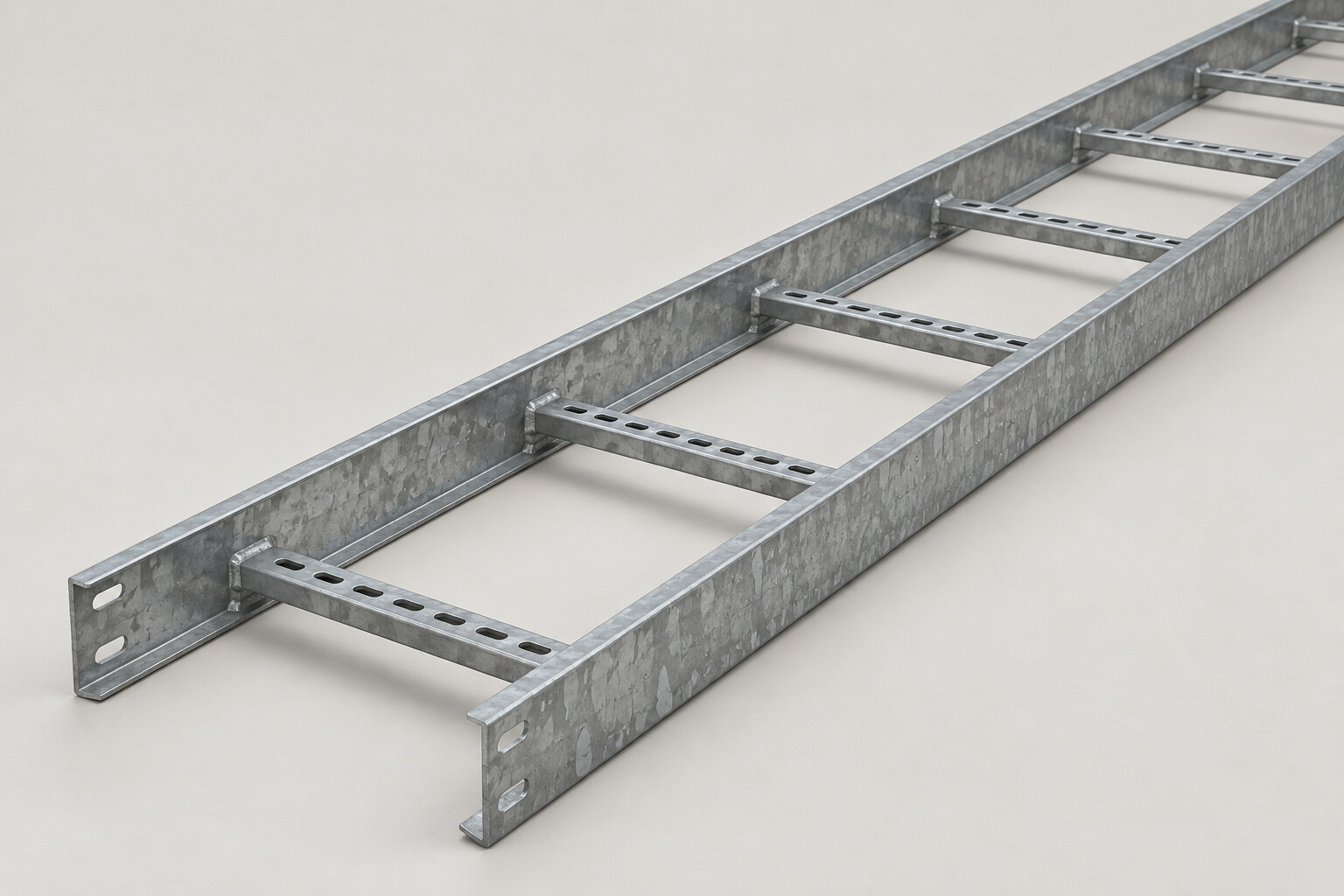
Short answer: a perforated cable tray has a full slotted base, so cables are supported along their entire length. It suits control, instrumentation and small to medium power cables. A cable ladder is built like a ladder, with two side rails joined by rungs every 300 mm. It is stiffer and more open to airflow, and suits large power cables, long support spans and main cable routes.
If your design comes from a NEMA or IEC based specification, the terms map directly. NEMA wording calls a cable ladder a ladder cable tray and a perforated tray a ventilated trough cable tray, while IEC wording lists cable tray and cable ladder as separate products. On site, the choice comes down to the same questions: how big the cables are, how heavy the run is and how far apart the supports can be.
Side-by-side comparison
Aspect | Perforated cable tray | Cable ladder |
|---|---|---|
Shape | U or C trough with a slotted, perforated base | Two side rails joined by rungs |
Suitable cables | Control, instrumentation, small to medium power | Large power, medium voltage, heavy cables |
Typical support spacing | 1.5 to 2.5 m | 2.5 to 3 m |
Airflow around the cables | Good | Very good |
Cable fixing | Through the slots in the base | Directly to the rungs |
Common sizes (width x height, mm) | 100 x 50 to 600 x 100 | 300 x 100 to 1,000 x 152 |
When to choose a perforated cable tray
Choose cable tray when a route carries many small-diameter cables. On a cable ladder, small cables sag between rungs that are 300 mm apart. The installation looks untidy, and the cable insulation is pressed again and again against the rung edges. The base of a tray supports the cables continuously, so neither problem occurs.
A tray is also easier to fit with a full cover. For routes in dusty areas, or routes that are exposed from above, a covered tray is the practical choice. In a plant, this typically means the control, instrumentation and small power distribution routes. Sizes and finishes are on the cable tray product page.
When to choose a cable ladder
Choose cable ladder when the cables have a large diameter, for example medium voltage power cables or the main feeders from a transformer to a panel. Cables like these are stiff enough not to sag between the rungs, and their weight is better carried by tall side rails.
A ladder is also the better option when the supports cannot be placed closer together: on pipe racks, on cable bridges between buildings, or on steel structures with widely spaced columns. For these cases, specify cable ladder type W or heavy-duty cable ladder. The full range is on the cable ladder page.
Where the cost difference really comes from
For the same width, a cable ladder and a 100 mm high cable tray are not far apart in price. The difference in total cost comes from the number of supports. A ladder that can be installed with longer support spacing needs fewer hanger beams, hanger rods and anchors.
For a procurement team comparing bids, this means comparing the whole route (trays, fittings and supports), not only the cost per length of tray. Count the supports for both options before you decide, then request a quotation for both options at the same time.
Using both on one project
On many projects the two are used together: cable ladder for the main route from the substation or panel room, then cable tray for distribution to the loads. Because the splice holes and join sets in our range are uniform, the change from ladder to tray is made with a reducer and a fish plate.
Frequently asked questions
Can a cable ladder carry small control and instrument cables?
It can, but it is not the right choice for a route with many small cables. They sag between rungs set 300 mm apart and the insulation is pressed against the rung edges. A perforated cable tray supports them continuously along the route.
What support spacing should I plan for each system?
Typical support spacing is 1.5 to 2.5 m for perforated cable tray and 2.5 to 3 m for cable ladder. Check the final spacing against the cable weight on your route. The details, including the rules at joints and fittings, are in our guide to cable tray support spacing.
Is a cable ladder more expensive than a cable tray?
For the same width, a cable ladder and a 100 mm high cable tray are close in price. The total cost depends more on the number of supports, and the longer support spacing of a ladder reduces the hanger beams, hanger rods and anchors you need. Ask for both options in one quotation and compare the complete route.
Can a route change from cable ladder to cable tray?
Yes. The splice holes and join sets are uniform across our ladder and tray range, so the transition is made with a reducer and a fish plate. Many projects use exactly this layout: a ladder backbone that feeds tray branches to the loads.