Comparisons · 26 October 2026 · 8 min read
Cable tray or conduit: when to use each on a project
Use cable tray for main routes that carry many cables and may get more. Use conduit for branches with a few cables that need full enclosure all the way to the device.
Written by the Ponggawa technical team
Also available in: Bahasa Indonesia · 简体中文
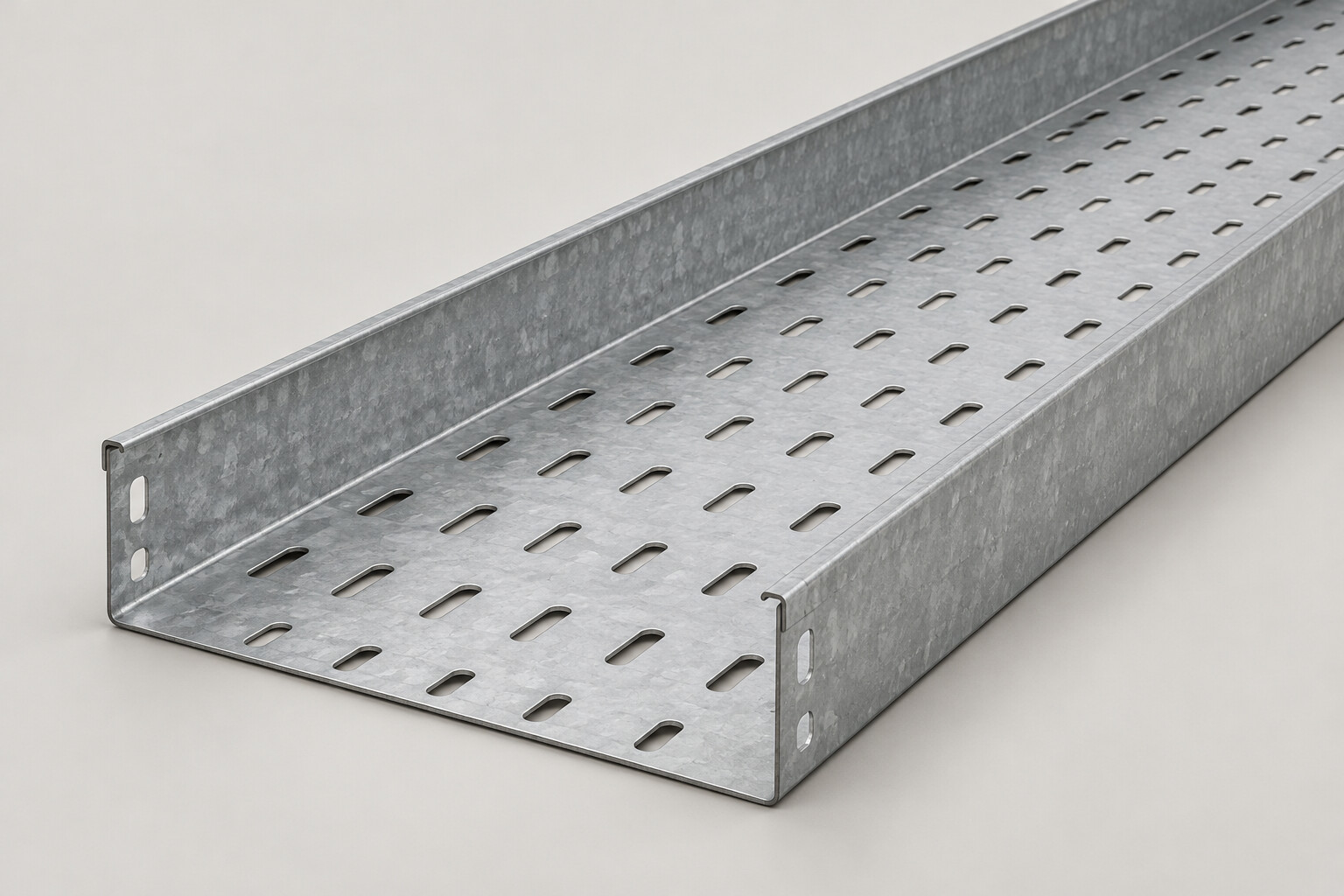
Short answer: use cable tray for main routes that carry many cables, have many bends or branches, and are likely to receive additional cables. Use conduit for branches with a few cables that run to a single device and need to be enclosed along their whole length. On industrial projects the two can work together: tray as the main route, conduit as the final run to the load.
For an EPC team or plant engineer preparing a design or a BOQ for a facility in Indonesia, the practical question is where the tray scope ends and the conduit scope begins. This article covers that split and what to mark on the drawings so a local supplier can quote the tray side completely.
Basic differences between cable tray and conduit
Cable tray is an open steel trough. Cables are laid on its base and then tied down. Perforated cable tray uses a slotted base that supports the cables along the route and keeps air circulating, with widths from 100 to 1,000 mm, heights of 50 or 100 mm and a standard length of 3,000 mm per piece.
Conduit is an enclosed pipe, made of metal or PVC. Cables are not laid in it but pulled through, from one end to the other or from one pull box to the next. Each pipe carries a few cables, and the pipe wall protects the cables inside.
This difference in how cables go in drives almost every decision that follows: how easily cables can be added, how many cables can practically be carried, and how the route changes on site.
Aspect | Cable tray | Conduit |
|---|---|---|
Form | Open trough, slotted base | Enclosed pipe (metal or PVC) |
How cables are installed | Laid on the base, then tied | Pulled through the pipe |
Cables per route | Many cables in one tray | A few cables per pipe |
Adding cables | Lay them directly in the tray while capacity allows | Pull new cables into an occupied pipe, or install a new pipe |
Mechanical protection | Open, a cover can be added | Enclosed by the pipe wall |
Cable heat dissipation | Perforated base keeps air circulating | Enclosed space, current-carrying capacity corrected by the electrical designer |
Bends and branches | Fittings (elbow, tee, cross, reducer, riser) | Pipe bends and pull boxes |
When cable tray is the better fit
Cable tray suits routes that carry many cables at once: from the transformer to the main panel, from the main panel to the distribution panels, or along a production corridor that serves many machines. One wide tray replaces a row of pipes that would each have to be installed, clamped and have cables pulled through one by one.
Tray also follows routes with bends and branches more easily. Horizontal bends use an elbow, branches use a tee or cross, width changes use a reducer, and elevation changes use an inside or outside riser. The full list is in the article cable tray accessories and their functions.
For power cables, the perforated base keeps air circulating around the cables. When the route needs protection from dust, sunlight, rain or objects falling from above, a cover can be added to the tray without changing the system. The guidance is in the article when a cable tray needs a cover.
When conduit is the better fit
Conduit suits branches with a few cables that run to a single point: a motor, a light fixture, a sensor, a push button or a wall-mounted control box. The narrowest cable tray is 100 mm wide, while a branch like this carries only one or two small cables.
Conduit is also used when cables must be enclosed along their whole length, for example where they drop down a wall or column to a device. The pipe wall protects the cable, so no section of cable is exposed between the tray and the device.
Like a duct, conduit is an enclosed space. Cables inside it dissipate heat more slowly than cables in an open tray, so the electrical designer calculates a current-carrying capacity correction according to the installation standard the project uses. The same principle for duct is explained in the article cable duct or cable tray.
Which makes adding cables easier
With cable tray, a new cable is simply laid on the base and tied, as long as the tray width and fill ratio still allow it. That is why spare capacity for future cables should be part of the sizing calculation from the start. The article how to size a cable tray uses a spare allowance of 20 to 25 percent and a fill ratio of 0.4 for a mix of power and control cables.
With conduit, a new cable has to be pulled into a pipe that already holds other cables. The installation standard sets limits on pipe fill and on the number of bends between pull boxes, so adding a cable may not be possible and can end with a new pipe. For routes that are expected to grow, for example a production area that will be extended, tray gives clearer room for growth.
Combining tray and conduit near the panel
In panel rooms and machine areas, tray and conduit meet. The working pattern can be arranged like this:
- The tray carries cables from the panel along the main route to a point near the group of loads.
- At the branch point, the cable for a single device leaves the tray.
- From that exit point, the cable enters a conduit and continues to the device.
Two tray accessories should be counted in this area. A tray end that does not connect to another section is closed with an end plate, and control cables that share a tray with power cables are separated with a straight separator.
The exit point from tray to conduit should be shown on the shop drawing: where the cable exits, how the conduit end is clamped or supported, and the distance to the nearest support. These transition details are easier to agree on the drawing than to decide on site once the cables are already pulled.
For lighting, socket outlet and instrument cables in buildings, there is a third option between tray and conduit: raceway, a small covered steel channel in sizes of 40 x 30, 40 x 40 and 70 x 40 mm, mounted directly on the wall or suspended with a hanger support.
Do cables in a cable tray need conduit protection
The electrical designer decides this based on the installation standard and the conditions in the area. On the drawings, check where cables leave the tray unsupported on the way to a device and where cables drop down in areas that people, forklifts or equipment can reach.
When the whole route needs to be enclosed, the answer is not always conduit. The tray can be fitted with a cover, or the route can use cable duct instead, a steel trough without perforations and with a cover that protects cables from dust, water splashes, sunlight and mechanical damage. Because duct is also enclosed, the current-carrying capacity correction for the cables still applies.
Summary of choices by situation
Situation | Choice |
|---|---|
Main route from the panel with many power cables | Cable tray or cable ladder |
Route that will receive additional cables | Cable tray with spare capacity |
Branch of one or two cables to a motor, light fixture or sensor | Conduit |
Route with many cables that must be fully enclosed | Cable duct, or cable tray with a cover |
Lighting and socket outlet cables in buildings | Raceway or conduit |
Ponggawa supplies the tray side of this system: cable tray, cable ladder, cable duct, raceway, wiremesh, fittings, covers and supports. Conduit is not part of the Ponggawa product line, so pipes and their accessories are ordered from a pipe supplier.
Send your route drawings, BOQ or cable schedule via the contact page for a project quotation covering tray, fittings, covers and supports. Mark the tray to conduit transition points on the drawings, so the number of end plates, separators and supports at those points is included in the count. To work out the tray width first, use the method in the article how to size a cable tray.
Frequently asked questions
Do cables in a cable tray need conduit protection at certain points?
The electrical designer decides, based on the installation standard the project uses and the conditions in the area. The points to check are where cables leave the tray on the way to a device and where cables drop down in areas that people or vehicles can reach. When the whole route needs to be enclosed, a tray cover or cable duct can also be an option.
Which makes it easier to add cables later, cable tray or conduit?
Cable tray. A new cable is simply laid on the tray base and tied, as long as there is still enough capacity. With conduit, a new cable has to be pulled into an occupied pipe, and the pipe fill limit can force the installation of a new pipe.
How do tray and conduit work together near the panel?
The tray carries cables from the panel along the main route to a point near the loads. At the branch point, the cable for a single device leaves the tray and continues in conduit to the device. Show this exit point on the shop drawing so the position, supports and accessories are clear before installation.
Does conduit trap more cable heat than cable tray?
Conduit is an enclosed space, so cables inside it dissipate heat more slowly than cables in a perforated tray. The electrical designer corrects the cable current-carrying capacity according to the installation standard. For power cables, this correction can affect the cable cross-section size.
Does Ponggawa supply conduit?
No. Ponggawa supplies cable tray, cable ladder, cable duct, raceway, wiremesh and the fittings, covers and supports to install them. For routes that use both, send the complete drawings and mark the tray sections, so the quotation covers every component on the tray side.