Technical guides · 19 October 2026 · 4 min read
How to size a cable tray from the number of cables
A simple method to calculate cable tray width from cable diameters and quantities, with a worked example and the fill ratios commonly used.
Written by the Ponggawa technical team
Also available in: Bahasa Indonesia · 简体中文
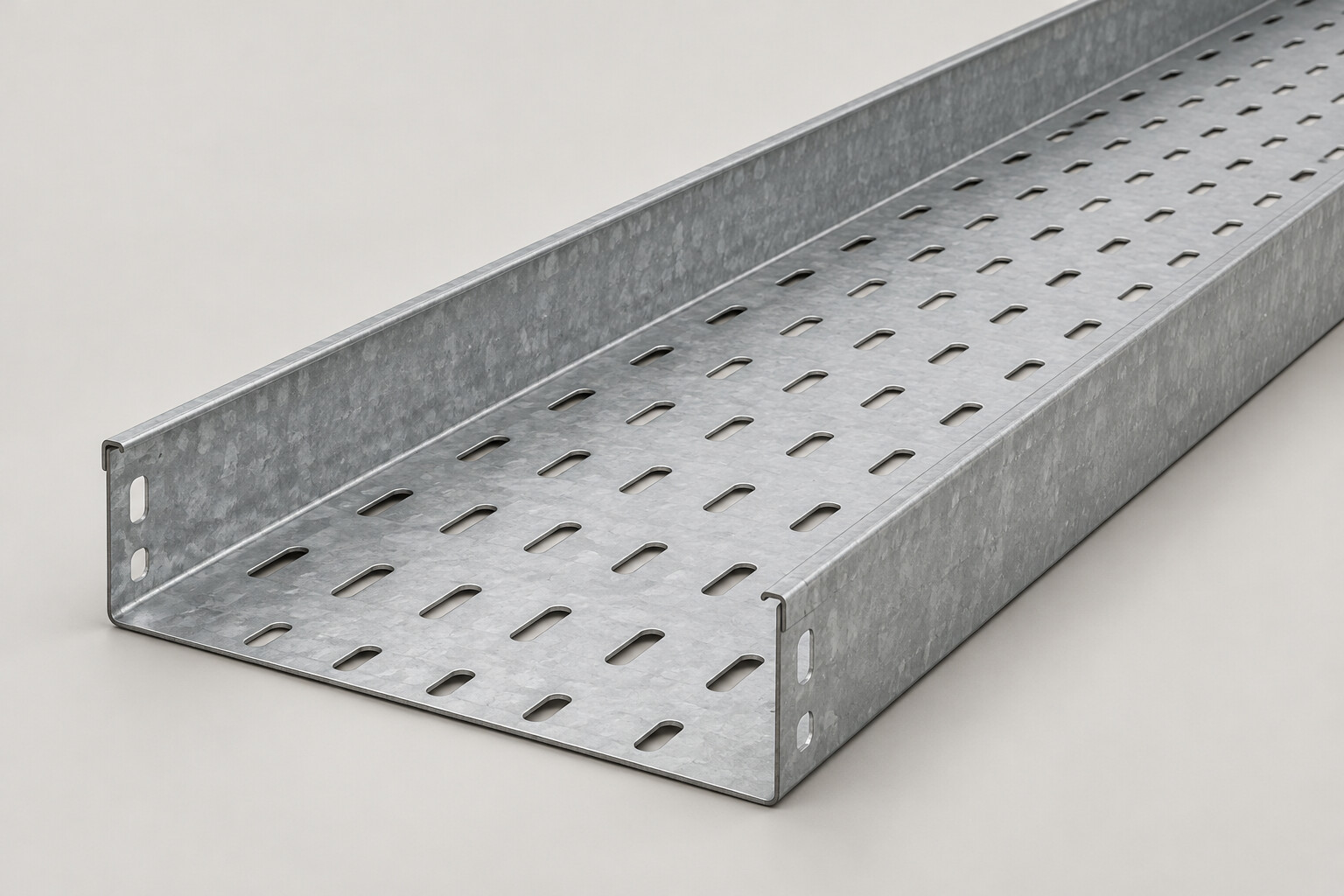
Short answer: add up the cross-sectional area of all cables (π × outer diameter² / 4, multiplied by the number of cables) and divide by the allowed fill ratio, for example 0.4. The result is the minimum tray area. Divide it by the tray height to get the minimum width, then choose the next standard width above it.
This is the calculation an EPC design team or an electrical subcontractor runs when turning the cable schedule into cable tray sizes for the BOQ. If your project specification sets its own maximum fill, use that value in place of the ratios below; the method stays the same.
Calculation steps
- Take the outer diameter (OD) of each cable type from the cable manufacturer's datasheet.
- Calculate the area of one cable: π × OD² / 4.
- Multiply by the number of cables, then add up all cable types.
- Add spare capacity for future cables, usually 20 to 25 percent.
- Divide by the fill ratio: 0.4 for a mix of power and control cables.
- Divide the result by the tray height (50 or 100 mm) to get the minimum width.
- Choose the smallest standard width that is equal to or larger than that minimum.
Worked example
A route carries 8 cables with an outer diameter of 25 mm and 12 cables with an outer diameter of 16 mm.
- Area of the 25 mm cables: 3.1416 × 25² / 4 = 490.9 mm², multiplied by 8 = 3,927 mm²
- Area of the 16 mm cables: 3.1416 × 16² / 4 = 201.1 mm², multiplied by 12 = 2,413 mm²
- Total: 6,340 mm². With 20 percent spare capacity this becomes 7,608 mm²
- Minimum tray area at a 40 percent fill ratio: 7,608 / 0.4 = 19,020 mm²
- Minimum width at a height of 100 mm: 190 mm
The nearest standard width above 190 mm is 200 mm, so the route needs a cable tray 200 x 100. The standard widths and heights are listed on the cable tray product page.
Fill ratios commonly used
Condition | Fill ratio |
|---|---|
Small control and instrumentation cables | 50 percent |
Mixed power and control cables | 40 percent |
Large power cables that need cooling | 30 percent |
For medium voltage power cables laid in a single layer with spacing between them, the calculation is no longer based on area. It is based on the sum of the cable diameters plus the spacing between cables, following the current rating rules of the electrical installation standard used on the project. Large cables like these are usually better carried on a cable ladder; our comparison of cable tray and cable ladder explains why.
50 or 100 mm high?
A tray 50 mm high suits control and instrumentation cables in small numbers. A tray 100 mm high gives twice the capacity at the same width and is stiffer, so for power cables it is almost always more efficient to choose a height of 100 mm than to increase the width.
The height also affects the supports. A taller tray can usually span further between supports, which our guide to cable tray support spacing covers in detail.
Let us run the numbers
Send your cable schedule or BOQ through our quotation request form and our team works out the tray sizes and the materials for each route. Include the cable outer diameters and quantities per route, the spare capacity you want to keep, and any fill limit set by the specification.
Frequently asked questions
What fill ratio should I use for cable tray?
Commonly used values are 50 percent for small control and instrumentation cables, 40 percent for mixed power and control cables, and 30 percent for large power cables that need cooling. If the project specification sets a different limit, use that one.
How much spare capacity should I allow?
Spare capacity for future cables is usually 20 to 25 percent of the total cable area. Add it before dividing by the fill ratio, as in the worked example above.
Should I choose a 50 mm or a 100 mm high tray?
A 50 mm high tray suits control and instrumentation cables in small numbers. A 100 mm high tray gives twice the capacity at the same width and is stiffer, so it is almost always the more efficient choice for power cables.
How do I size a tray for medium voltage cables in a single layer?
Do not use the area method. Add up the cable diameters plus the spacing between cables, following the current rating rules of the electrical installation standard that applies to the project, and choose the width from that total.