Technical guides · 25 October 2026 · 7 min read
Cable tray cover: when you need one and how to size it
Fit a cover when the route is exposed to dust, fibers, sun, rain or objects falling from above. Cover width follows tray width, and every fitting takes its matching fitting cover.
Written by the Ponggawa technical team
Also available in: Bahasa Indonesia · 简体中文
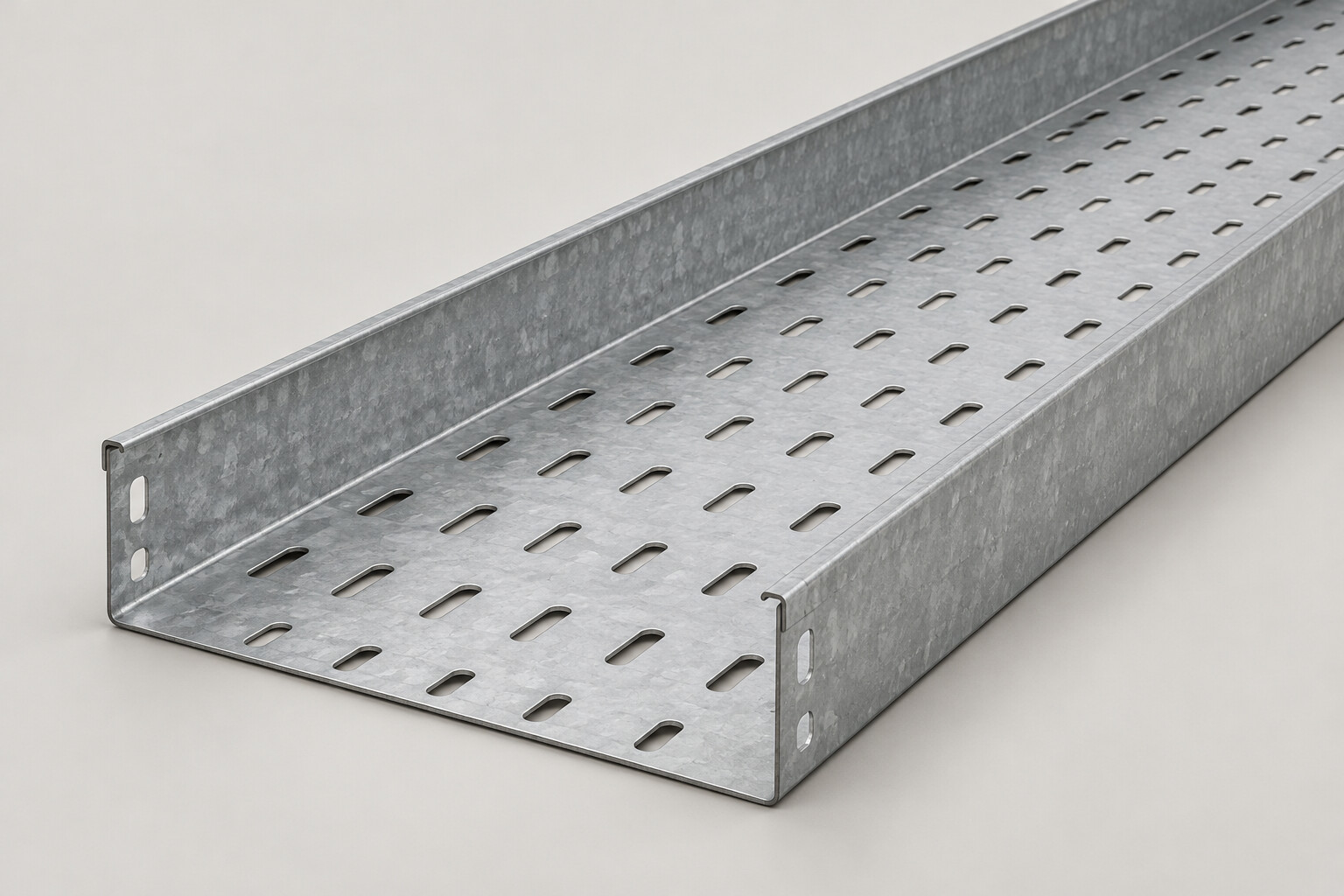
Short answer: a cable tray cover is needed when the cable route is exposed to dust or fibers that build up easily, to sun and rain outdoors, or runs below a work area where objects may fall onto it. In clean indoor spaces, perforated cable tray is usually left open so the cables can release heat easily. Cover width follows tray width, and every elbow, tee, cross, reducer and riser takes its matching fitting cover.
For engineers and procurement teams preparing a BOQ for a plant in Indonesia, this means covers are a line item you decide segment by segment, based on the route environment, and then size from the tray data.
Does every cable tray need a cover?
No. On perforated cable tray, the cover is an optional accessory. The slotted base is designed to keep air circulating around the cables and to make cable tying easier, so routes in building ceilings or clean panel rooms are generally left uncovered.
Covers only go into the BOQ when route conditions call for them. The standard component list on the cable tray accessories page states this clearly: the cover and cover clamp are added when the route needs to be covered. Other components that are always required, such as join sets, supports and hold-down clamps, are covered in the article on cable tray accessories and their functions.
Situations that call for a cable tray cover
The decision to use a cover starts from the route environment, not from the tray size. The table below summarizes conditions commonly found in Indonesian industrial estates.
Route condition | What happens without a cover | Recommended option |
|---|---|---|
Cement plants and dusty material areas | Dust builds up on the cables and reduces heat release; cement dust is also abrasive | HDG tray with cover, or enclosed cable duct |
Textile mills | Cotton fiber builds up in open tray, traps cable heat and adds fire risk | HDG tray with cover |
Humid, oily palm oil mills | Moisture and oil in the air reach the cables directly in open tray | HDG tray with cover; avoid powder coating in areas exposed to hot steam |
Outdoor routes between buildings and pipe racks | Cables are exposed to direct sun and rain | Cable ladder or HDG tray with top cover |
Routes below work areas or exposed from above | Falling objects and debris hit the cables directly | Tray with cover, or cable duct when full enclosure is needed |
Ponggawa's regional guidance gives real examples. The cement estates in Bogor and Depok suit enclosed cable duct or tray with cover. In the textile areas of Bandung, covers are strongly recommended because cotton fiber builds up easily. For outdoor routes between factory buildings in Karawang, HDG cable ladder with a top cover protects the cables from heat and rain.
High-rise buildings have their own needs. In Jakarta projects, many cable routes run through ceiling plenums and vertical shafts, so the requirement is medium-size perforated cable tray, risers, and covers for the shafts.
How a cover affects cable cooling
A cover restricts airflow above the cables. The principle is the same as with cable duct: cables in an enclosed trunking release heat more slowly, so their current-carrying capacity has to be derated compared with cables in open tray. The full explanation is in the article on cable duct vs cable tray.
On the other hand, open tray in a dusty area is not automatically cooler. A layer of dust or fiber that builds up on the cables also traps heat. In this kind of environment, the cover and cover clamp actually prevent that buildup.
Because these two effects work against each other, do not add or remove covers on power cable routes without the approval of the project's electrical designer. The designer calculates whether the cable cross-section or the current-capacity derating needs to be adjusted.
How to size a cable tray cover
A cover is ordered to match its tray, so the tray data must be complete first. Follow this sequence when preparing the BOQ.
- Define tray width and height. Calculate the width from the number and diameter of the cables, or, if you want the width checked, send the cable list via the contact page. Tray widths are available from 100 to 1,000 mm, heights 50 or 100 mm.
- Match cover width to tray width. A 300 x 100 cable tray takes a 300 mm wide cover, and a 600 x 100 tray takes a 600 mm wide cover. In the BOQ, also state the tray type (type U or type C) on the cover line so the cover quotation matches the tray ordered.
- Count straight covers per 3 m length. Each straight tray length in the covered section needs one straight cover length. A 30 m covered route means 10 tray lengths and 10 cover lengths.
- Add fitting covers at every bend and branch. Covers are available for straight, elbow, tee, cross, reducer and riser. A reducer cover follows the reducer's width pair, for example 400 to 300 mm.
- Include cover clamps. List them as a separate item so they are not missed, then confirm the quantity in the quotation.
- Match the finish. The accessory finish follows the tray finish. Outdoor, humid and coastal routes use hot-dip galvanized; dry indoor spaces can use electro-galvanized.
Also mark on the route drawing which sections are covered and which are open. A single route may be covered only on certain segments, for example the part that crosses above a production area.
What a cover clamp does
A cover clamp locks the cover to the tray. Without it, the cover only rests on top of the tray side rails.
For cable duct, this function is stated clearly in the product data: the cover is fastened with cover clamps so it does not shift under vibration. In dusty areas, the cover and cover clamp together keep the route closed so dust does not build up on the cables. For that reason, order cover clamps together with covers every time a route is covered.
Tray with cover, cable ladder, or cable duct?
A cover on a tray protects the cables from above, but the base still has slots. When the route needs full protection from dust, water splash and sunlight, or data cables must be physically separated from power cables, unperforated cable duct is the better fit. The duct cover is 1.2 mm thick and removable.
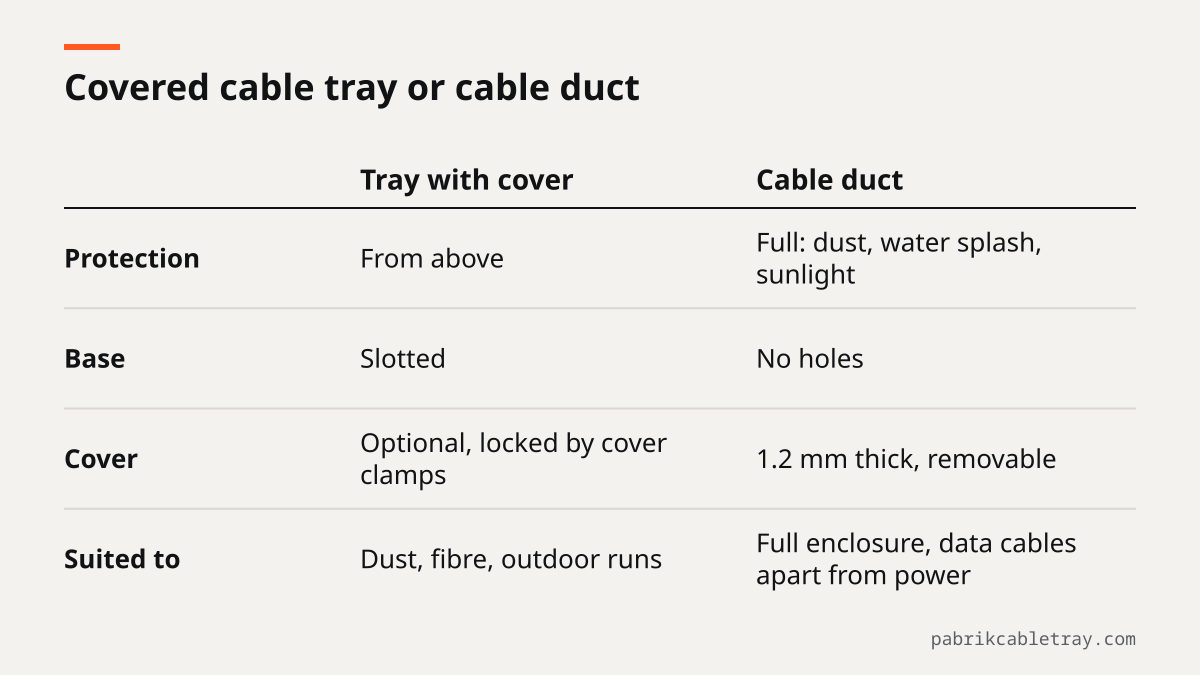
For cable tray, type U has upright side rails with an inner lip that is easy to join and fit with a cover. Cable ladder can also take a top cover on outdoor routes, as on the pipe racks of the Serang and Cilegon estates, which use a top cover where the cables are exposed to direct sunlight.
Cover cost in the quotation
Covers are priced separately from the tray, per 3 m length, and the quotation itemizes both. Cover cost also depends on tray width, finish, the number of fitting covers and the length of route that is covered. A BOQ that separates covered and open segments therefore produces a more accurate figure.
Send your route drawings, BOQ or cable schedule via the contact page and mark the segments that need covers. The Ponggawa team prepares a quotation that itemizes tray, covers, fitting covers, cover clamps and supports in one list.
Frequently asked questions
Does every cable tray need a cover?
No. Covers on perforated cable tray are optional and are fitted only when the route needs to be covered, for example in dusty areas, textile mills, outdoor routes or below work areas. In clean indoor spaces, the tray is usually left open so the cables can release heat easily.
How does a cover affect cable cooling?
A cover restricts airflow above the cables, so the cables release heat more slowly and their current-carrying capacity may need to be derated. In dusty areas, dust buildup on the cables also traps heat, and the cover prevents that buildup. The project's electrical designer decides on the derating.
What does a cover clamp do?
A cover clamp locks the cover to the tray so the cover stays in place. On cable duct, the cover clamp holds the cover so it does not shift under vibration. Order cover clamps together with covers every time a route is covered.
What cover width do I need for a 300 mm cable tray?
A cover for a 300 mm wide tray is also 300 mm wide. In the BOQ, state the tray type (type U or type C) and the number of 3 m lengths so the cover quotation matches the tray, then add a cover for every fitting on the same route.
Is the cover included in the cable tray quotation?
No. Straight tray and covers are priced separately per 3 m length, and the quotation itemizes both. Mark the segments that need covers on the drawing or BOQ so the quantities are correct.