Article · 27 October 2026 · 8 min read
IEC 61537 cable tray or NEMA VE 1: reading a spec for Indonesia
NEMA VE 1 rates cable tray by load class, IEC 61537 by a declared safe working load at a stated span. Confirm which one your spec requires and what test evidence the supplier can show.
Written by the Ponggawa technical team
Also available in: 简体中文
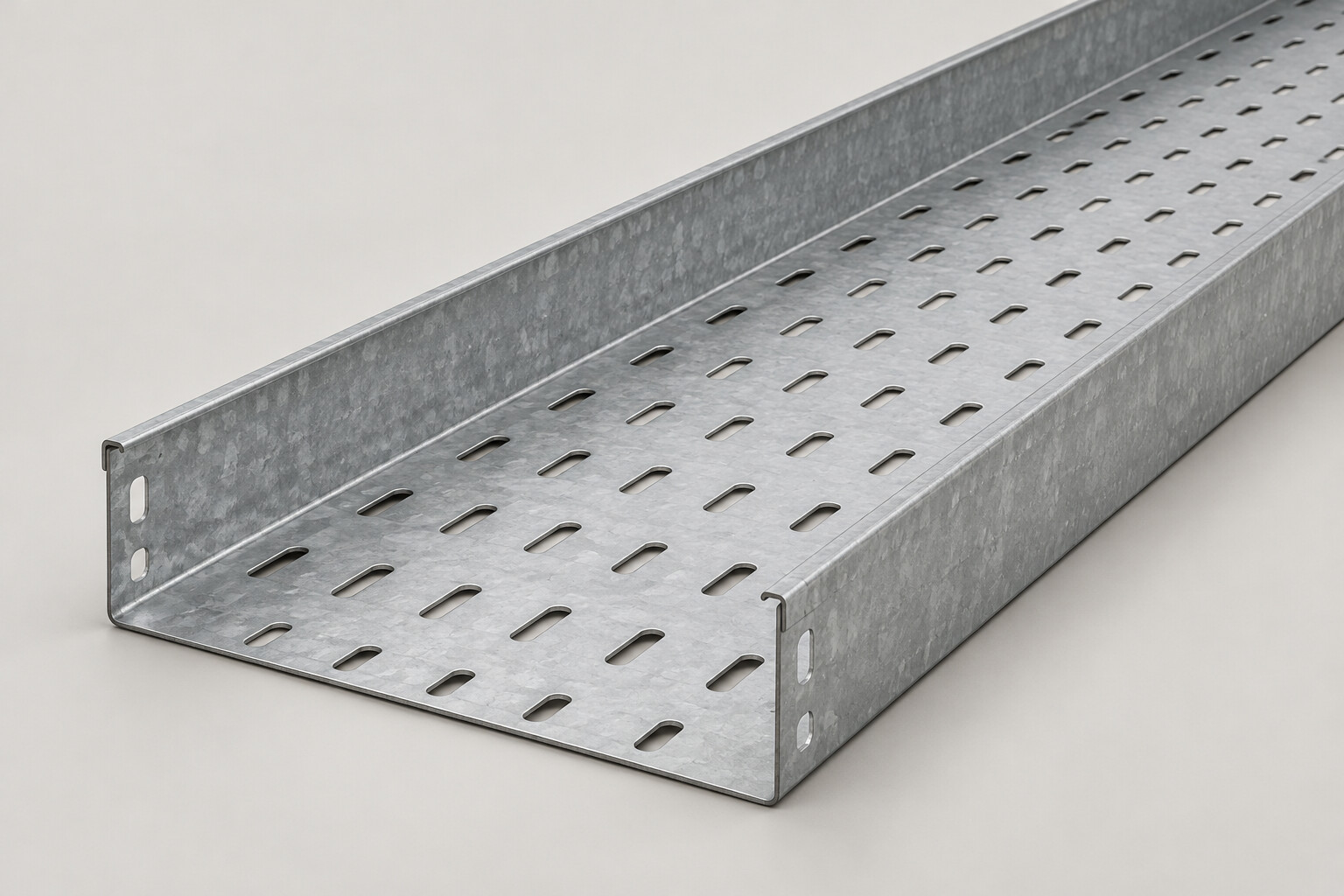
Short answer: NEMA VE 1 and IEC 61537 both cover metal cable tray and cable ladder systems, but they express load capacity differently. NEMA VE 1 uses load classes that combine a support span and a working load category, while IEC 61537 has the supplier declare a safe working load at a stated span. When your design package cites one standard and the local product is rated to the other, settle the gap in a technical query before the quotation, not on site.
Why this question comes up on Indonesian projects
Indonesian project specifications often cite NEMA VE 1 together with IEC 61537 as references for metal cable tray. A design package prepared in Europe, China or the Middle East may cite only IEC 61537. A package from a US-based engineer may cite only NEMA VE 1.
The cable support products Ponggawa supplies are designed per NEMA VE 1. They are made by a partner manufacturer in Bekasi, West Java, from hot rolled sheet steel SPHC with a plate thickness of 1.8 to 2.0 mm (other thicknesses to order) and a standard length of 3,000 mm. So the practical question for a foreign design team is this: what does the specification actually require, and what evidence can the supplier put on the table?
How the two standards express load capacity
The main difference you will see on a datasheet is the way the load rating is written.
Point to compare | NEMA VE 1 | IEC 61537 |
|---|---|---|
Origin | National Electrical Manufacturers Association (US) | International Electrotechnical Commission |
How load capacity is stated | Load class, for example 10A, 12B, 20C | Safe working load declared at a stated span |
What a class or rating tells you | The number is the support span in feet, the letter is the working load category | The load the system carries at the span the supplier declares |
Deflection | Measured under uniform load against a limit expressed as a fraction of the span | Measured in the load test, with the result tied to the declared span |
Main content | Load test method, deflection limit, safety factor and load classes | Load test method and safe working load, plus a classification of properties beyond load, such as material and electrical continuity |
On NEMA VE 1 classes, class 10A means a 10 foot span (about 3 m) with load category A. A higher number means a longer span and a later letter means a heavier load category. Our article on NEMA VE 1 load classes explains how to read them in more detail.
An IEC 61537 rating is not a class from a fixed table. It is a declaration that belongs to one product, at one span, under the test arrangement the standard describes. This is why a NEMA class and an IEC declaration cannot be swapped one for one on paper.
What the test figure for a NEMA VE 1 product looks like
A concrete example helps the comparison. The partner manufacturer in Bekasi made a cable ladder type W, 1,000 mm wide and 100 mm high, with 2.0 mm plate. An independent laboratory load tested it on a 2.5 m span.
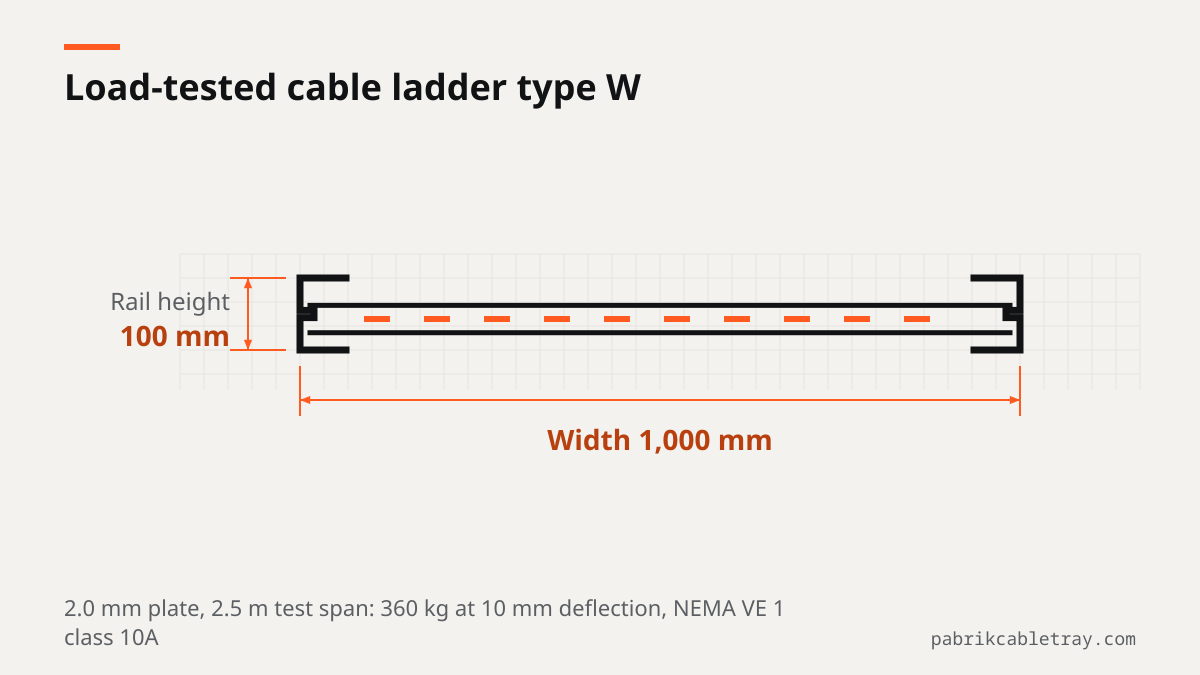
The result: 360 kg at the 10 mm deflection limit, which is 1/250 of the span. The laboratory reported this result for the 2.5 m test span as NEMA VE 1 class 10A. The sample carried up to 550 kg per span.
Read this figure for what it is. It is a NEMA VE 1 result for one configuration of type W cable ladder, at one span. Capacity for other widths, rail heights, plate thicknesses and support spacings depends on those variables, so the capacity at your design support spacing still needs a calculation with your own span data. The article on cable ladder load capacity shows how to read the test result against a span.
Span: the variable that links both standards
Both standards tie capacity to the span between supports. A rating means little without the span it was tested at.
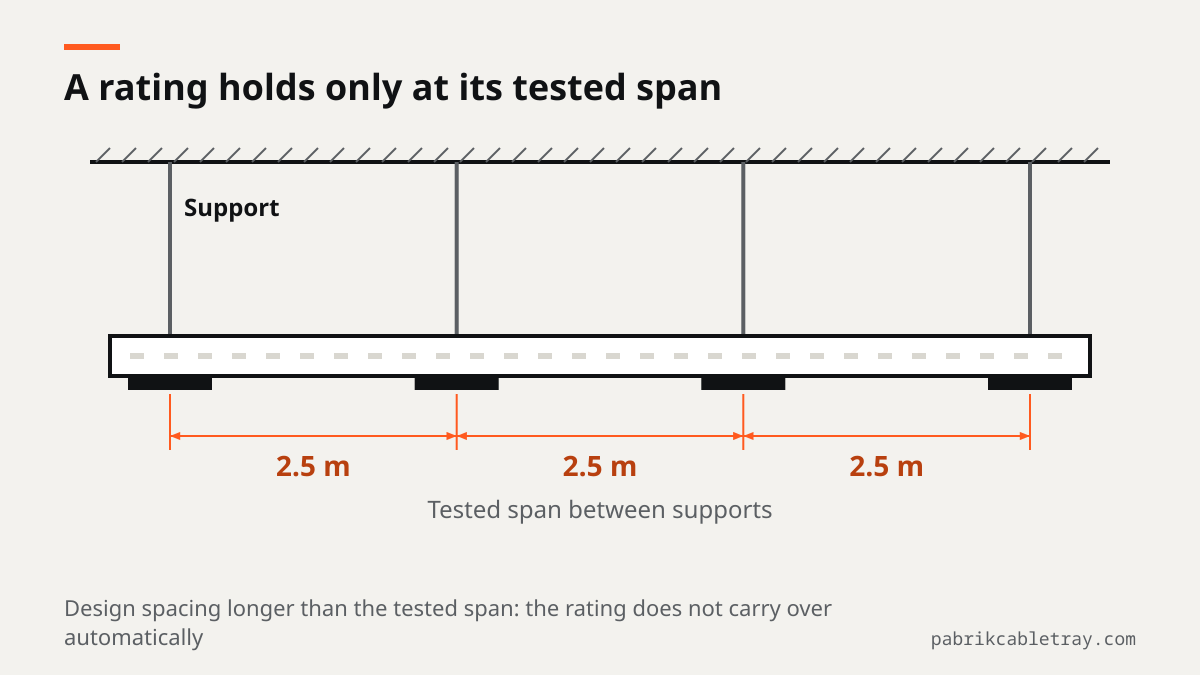
When your design package states support spacing in metres, check it against the span behind the rating you are offered. If the design spacing is longer than the tested span, the rating does not carry over automatically, and the project electrical designer decides how to treat it. Our guide to cable tray support spacing covers spacing rules at joints, bends and risers.
Can a product rated to one standard be accepted under the other?
That is a decision for the project engineer or the consultant who owns the specification, not for the supplier. The test methods and the way results are reported differ, so a NEMA VE 1 class is not an IEC 61537 declaration, and the reverse is also true.
What you can do is make the decision easy to take. Put the load the route must carry and the support spacing in front of the engineer, next to the test evidence the supplier can show. The real requirement in the specification can be a load at a span, with the standard named as the method used to prove it.
What to write in the technical query
A short, specific technical query (TQ) saves a round of rejected submittals. These are the points to raise:
- The standard that governs. If the specification names both NEMA VE 1 and IEC 61537, ask which one applies to load rating, or whether either is acceptable.
- The load requirement. State the cable load per metre the route must carry, or the load class or safe working load the design calls for.
- The support spacing. Give the design span for each route, so the rating can be checked against it.
- The product and size. Name the system (for example cable ladder type W or heavy duty), the width, the rail height and the plate thickness.
- The finish. State hot dip galvanized (BS 729, DIN 50976), electro galvanized or powder coating, depending on the environment. See hot-dip galvanized or electro-galvanized for the trade-offs.
- Electrical continuity. If the tray forms part of the grounding path, say how continuity is kept at joints. Our article on cable tray grounding and bonding lists what to write in the spec.
- The evidence you will accept. Ask the consultant whether a NEMA VE 1 load test report from an independent laboratory is acceptable for the submittal, or whether IEC 61537 test documents are required.
Point 7 is the one that decides the outcome. Ask it early, in writing, and attach the answer to the submittal.
What a local supplier needs from you to quote
A complete quotation needs the same inputs, whatever standard the design cites. Send route drawings, a BOQ or a cable schedule, plus the delivery site. Our checklist on what an Indonesian supplier needs to quote a cable tray BOQ lists every field.
Ponggawa prepares quotations per project, coordinates production with the partner manufacturer, carries out visual quality control and delivers to project sites from Bekasi across Indonesia. You can read more about how Ponggawa works.
If your design package cites IEC 61537, NEMA VE 1 or both, send the specification together with your drawings, BOQ or cable schedule through the contact page. We will match the type, rail height and plate thickness to the load requirement and tell you which test evidence is available, so your engineer can answer the TQ with the facts in hand.
Frequently asked questions
Which standard do Indonesian project specifications cite?
Indonesian project specifications often cite NEMA VE 1 together with IEC 61537 as references for metal cable tray. Design packages prepared abroad may cite only one of them. Check the specification clause by clause, because the load rating requirement may sit under a different standard from the finish or continuity requirements.
Can a cable tray tested to NEMA VE 1 be accepted on an IEC 61537 specification?
The project engineer or consultant decides, not the supplier. The two standards report load capacity differently, so one result does not convert into the other automatically. Raise a technical query that sets out the required load, the design span and the test evidence available, and ask which evidence the consultant will accept.
What should be written in the technical query?
State which standard governs the load rating, the cable load per metre or the required class or safe working load, and the support spacing for each route. Add the product, width, rail height, plate thickness, finish and continuity requirement. Close with a direct question on what test evidence the consultant will accept for the submittal.
What load test can Ponggawa show?
An independent laboratory tested a type W cable ladder, 1,000 mm wide, 100 mm high, with 2.0 mm plate, made by the partner manufacturer in Bekasi. On a 2.5 m span it carried 360 kg at the 10 mm deflection limit (1/250 of the span), which the laboratory reported as NEMA VE 1 class 10A, and the sample carried up to 550 kg per span. For other sizes or spans, send your span data for a calculation.
Does a NEMA VE 1 class like 10A tell me the support spacing?
Yes, the number in the class is the support span in feet, so 10A refers to a 10 foot span (about 3 m) with load category A. Check that span against the design spacing in your drawings. If your spacing differs, ask for the capacity at your actual span.