Article · 30 October 2026 · 8 min read
Cable tray finish for a coastal industrial estate: HDG or powder coat
For plants near the sea in Indonesia, specify hot dip galvanized cable tray and ladder with HDG bolts. Keep powder coating for indoor routes that need a colour.
Written by the Ponggawa technical team
Also available in: 简体中文
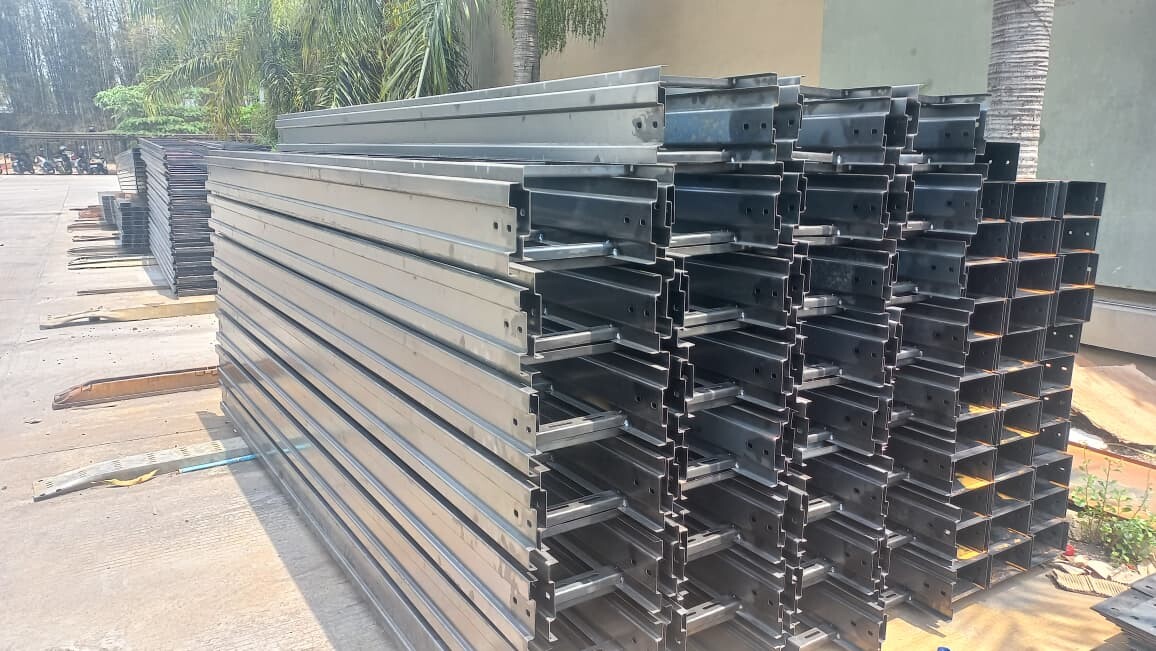
Short answer: For a plant in a coastal industrial estate in Indonesia, specify hot dip galvanized (HDG) cable tray and cable ladder for outdoor, process and humid areas, and make the bolts, nuts, hanger rods and clamps HDG as well. Electro galvanized is not recommended near the coast, because its zinc layer is too thin for salty air. Use powder coating where a route needs a colour, such as fire alarm routes or a data center hall, and confirm that choice with your project designer.
The three finishes Ponggawa supplies
Ponggawa supplies cable tray, cable ladder and cable duct in three finishes: hot dip galvanized, electro galvanized and powder coating. Wire mesh tray comes in electro zinc or HDG only. Each finish protects the steel in a different way, so the choice of cable tray finish for a coastal industrial estate starts with how each is applied.
Finish | How it is applied | Where it is used |
|---|---|---|
Hot dip galvanized (HDG), BS 729, DIN 50976 | The fabricated steel is dipped in molten zinc at about 450 °C, so every surface, including cut edges and holes, is coated | Outdoor, humid areas, coastal sites, heavy industry, chemical plants, smelters and power plants |
Electro galvanized (EG) | A thin zinc layer applied by electrolysis; smoother and brighter, lower cost, lower corrosion resistance than HDG | Dry indoor areas such as offices, malls, panel rooms and ceiling plenums |
Powder coating | Electrostatic powder paint, baked; colour to a RAL code | Fire alarm routes, data centers, exposed architectural areas, route identification |
For cable tray and cable ladder, the base material is hot rolled sheet steel (SPHC), plate 1.8 to 2.0 mm with other thicknesses to order, in standard 3,000 mm lengths and designed per NEMA VE 1. The finish is applied to that steel, so you specify thickness and finish as two separate lines. For a deeper look at the two zinc processes, see hot dip galvanized vs electro galvanized.
Why coastal estates point to HDG
Several of Indonesia's industrial corridors sit on the coast. In Surabaya and Gresik, with JIIPE Gresik and its smelter, petrochemical and port activity, salt air and chemical vapour make hot dip galvanized the minimum standard. In Batam, home to Kabil Industrial Estate, Tanjung Uncang and Nongsa Digital Park, the marine environment makes HDG a requirement for shipyards and coastal areas.
The same reasoning applies elsewhere. In Cilegon, around Krakatau Industrial Estate, cable routes generally run on open pipe racks exposed to heat, rain and chemical vapour. In Morowali and Weda Bay, the smelter sites are hot, dusty and close to the sea, and the finish there is thick HDG, with heavy duty cable ladder and HDG bolts.
The key property is coverage. Because HDG is applied after fabrication by dipping the whole part, the zinc also reaches cut edges, slots and the inside of bends. Electro galvanized steel has a much thinner layer, and its corrosion resistance drops when it meets water or salt air.
Where powder coating fits on a coastal plant
Powder coating is chosen for colour and identification, not as the default outdoor finish. Typical uses on an industrial project are red or orange trays for fire alarm routes, blue or grey for system identification, and powder coated trays in data center halls. Batam is an example: HDG for shipyard and coastal areas, powder coating for data center projects.
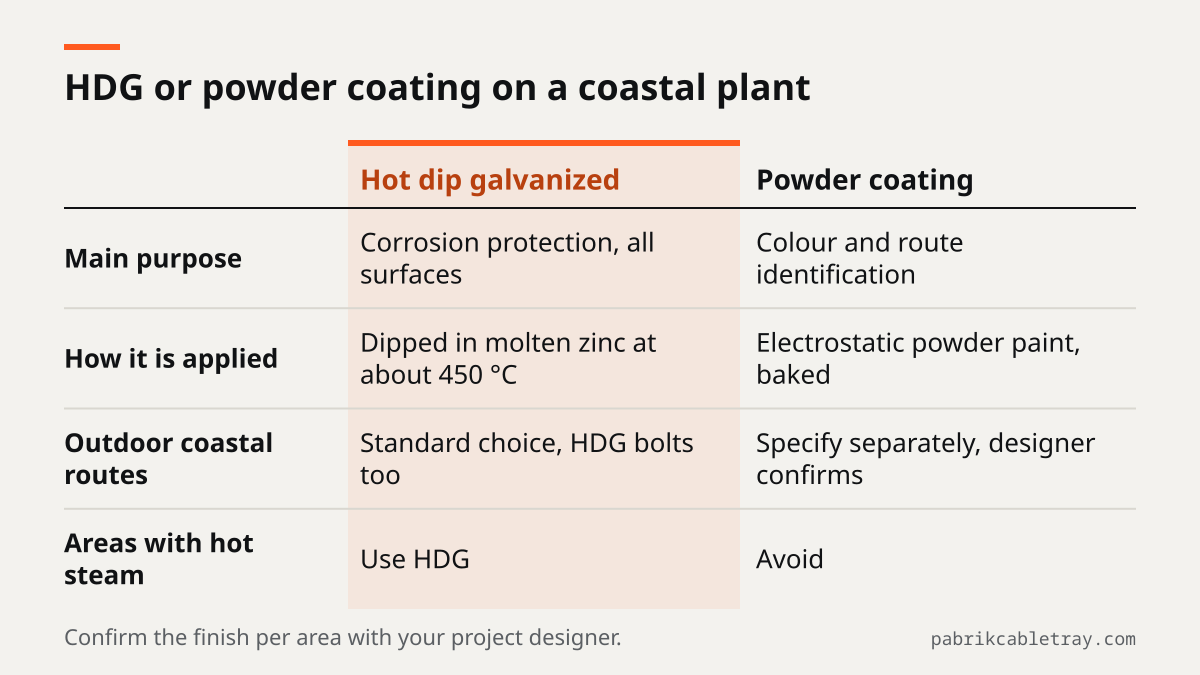
There are limits to keep in mind. For palm oil mills, avoid powder coating in areas exposed to hot steam and use HDG there. For enclosed cable duct installed outdoors, HDG or outdoor grade powder coating are both options, with small drainage holes at the lowest point where water could be trapped.
If your specification asks for a colour on top of galvanizing for an outdoor coastal route, write it as a separate requirement. Ask for it to be confirmed line by line in the quotation, and let your project designer decide whether the system meets the design.
Matching the finish to each area of a coastal plant
A plant on the coast rarely has one exposure everywhere. A coastal smelter or process plant can have waterfront structures, outdoor pipe racks, a substation, a control building and perhaps a server room. Split the BOQ by area so each finish line matches the salt and moisture that area actually sees.
Area of a coastal plant | Exposure near the sea | Finish line for the BOQ |
|---|---|---|
Jetty, port, shipyard, waterfront areas | Direct salt air | HDG tray or ladder, bolts and supports also HDG |
Outdoor pipe rack, rooftop, routes between buildings | Salt air, sun and rain | HDG, with a top cover where cables face direct sun and rain |
Process area, smelter, petrochemical unit | Salt air plus heat and chemical vapour | HDG, consider heavy duty cable ladder |
Basement, pump room, humid areas | Moisture | HDG |
Dry indoor control room or office ceiling | Closed, dry room | Electro galvanized is possible |
Data center hall | Closed, dry room | Powder coating; electro galvanized also suits a dry indoor room |
Fire alarm routes | Depends on the area | Red powder coating indoors; for outdoor routes, agree the system with the designer |
For main power routes on coastal pipe racks, cable ladder in type W or heavy duty is worth considering, so the span between structures can be longer. For distribution routes with smaller cables, cable tray in the same finish keeps the system consistent. On exposed routes, a top cover protects cables from sun and rain; see when a cable tray needs a cover.
What to write in the specification and BOQ
A finish line that only says "galvanized" invites two different quotations for the same BOQ, and on a coastal job that gap matters most. Use these steps to make the finish line complete.
- Name the process and the standard. Write "hot dip galvanized after fabrication to BS 729 / DIN 50976", not "galvanized" or "GI".
- State the finish per area. List waterfront, outdoor, process, humid and indoor areas separately, each with its own finish, as in the table above.
- Cover the small parts. Write that bolts, nuts, hanger rods and clamps in outdoor and coastal areas have the same finish as the tray. HDG tray fixed with electro galvanized bolts is a mix to avoid: the bolts rust first and stain the tray around them.
- Give the RAL code for any powder coating. Name the colour per route, for example red for fire alarm, and the areas where it applies.
- Add a touch-up clause. When HDG tray is cut on site, the cut edge loses its zinc protection. Require zinc rich paint on every site cut.
- Keep thickness and load class on their own lines. Plate thickness, NEMA VE 1 load class and support span are separate items from the finish.
The accessories need the same attention. Fittings, join sets, supports, covers and clamps each carry a finish, and a BOQ that lists them without one leaves a gap. The list in cable tray accessories in a BOQ helps you check every line.
What to confirm with the project designer
The finish decision belongs to the project's electrical designer or the owner's engineer, not to the supplier. Before the BOQ goes out, confirm these points with them:
- which areas count as outdoor, humid or coastal on this site;
- whether the specification sets a minimum zinc coating or a corrosivity category for the site, and which standard it refers to;
- whether any route needs a colour, and which RAL code;
- whether a coloured coating over galvanizing is required anywhere, and how it should be specified;
- how site cuts and damaged coating must be repaired.
If the design comes from abroad and refers to IEC 61537 rather than NEMA VE 1, settle that before you fix the finish lines. The article on NEMA VE 1 vs IEC 61537 for projects in Indonesia explains how the two standards read.
How the finish affects the quotation
The finish is one of the cost drivers in a cable tray quotation, together with width, height, plate thickness, the number of fittings and quantity. HDG needs an extra process after fabrication, so it costs more than electro galvanized. For outdoor and coastal areas, that difference is small compared with replacing a tray that has rusted.
Ponggawa prepares a quotation per project and coordinates production with its partner manufacturer in Bekasi, which holds ISO 9001:2015. Ponggawa then carries out visual quality control and delivers to the project site. Goods are bundled per size and shipped from Bekasi, by truck within Java and by sea freight to sites outside Java. You can read more about Ponggawa.
To get a quotation for a coastal plant, send your route drawings, BOQ or cable schedule through the contact page. Mark the finish per area, the bolt finish and any RAL codes, and give the delivery site, for example the estate and the town. If a point is open, list it as a question and it will be answered in the quotation.
Frequently asked questions
Is electro galvanized enough near the coast?
No, electro galvanized is not recommended for coastal areas. Its zinc layer is too thin for salty air, and its corrosion resistance is lower than HDG. Use it only in dry indoor rooms, and specify HDG for outdoor, humid and coastal areas, with HDG bolts.
What should the finish line in a BOQ say?
Name the process and the standard, for example "hot dip galvanized after fabrication to BS 729 / DIN 50976". State the finish per area, require the same finish on bolts, nuts, hanger rods and clamps in outdoor and coastal areas, and add zinc rich paint on site cuts. For powder coating, give the RAL code and the routes it applies to.
Does the finish change the quotation?
Yes. The finish is a cost driver together with width, height, plate thickness, fittings and quantity, and HDG costs more than electro galvanized because of the extra process after fabrication. Write the finish per line in the BOQ so the quotation can price each line correctly.
Can powder coated cable tray be used outdoors at a coastal plant?
Powder coating is chosen mainly for colour and route identification, and HDG is the standard choice for outdoor and coastal areas. Avoid powder coating where it is exposed to hot steam. If your design calls for a colour on an outdoor route, specify it separately and let your project designer confirm the system.
Do bolts and supports need the same finish as the tray?
In outdoor and coastal areas, yes. Bolts, nuts, hanger rods and clamps should carry the same finish as the tray. Electro galvanized bolts on HDG tray rust first and stain the tray around them.