
Technical guides · 3 November 2026 · 9 min read
Outdoor and pipe rack cable tray: finish, covers and supports
Use HDG for the tray, bolts and supports, add a top cover where cables are exposed to direct sun, and choose cable ladder type W or heavy duty for pipe rack spans.
Written by the Ponggawa technical team
Also available in: Bahasa Indonesia · 简体中文
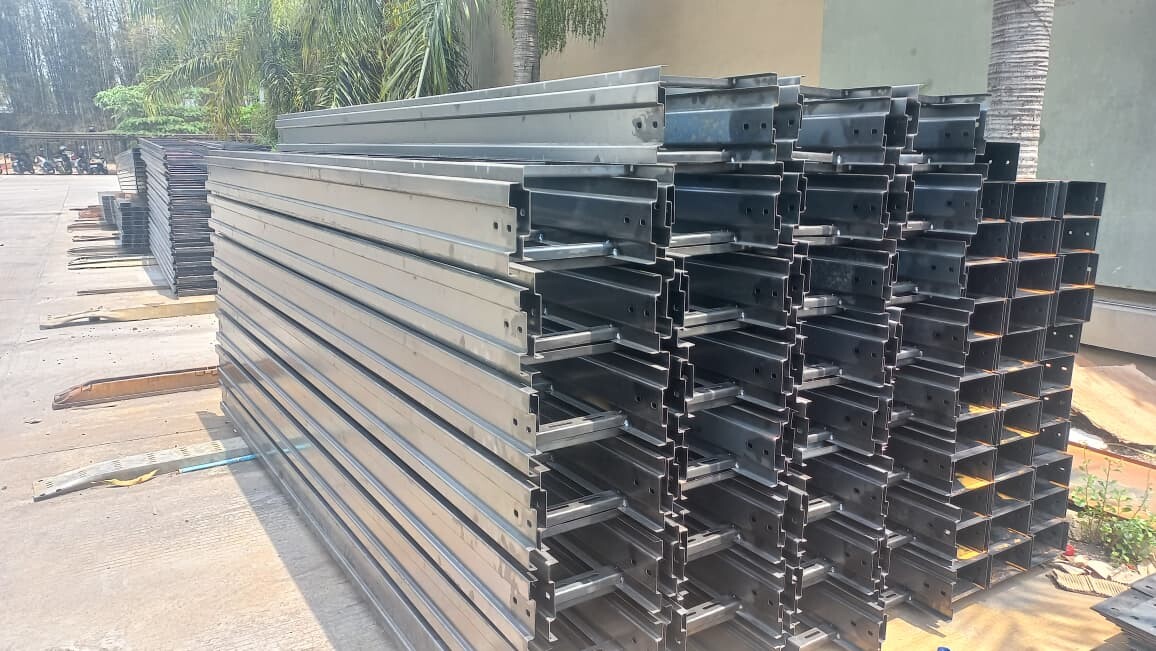
Short answer: outdoor cable tray uses a hot dip galvanized (HDG) finish, and the bolts, nuts, hanger rods and clamps are HDG as well. Install a top cover where cables are exposed to direct sun or rain. On a pipe rack, where the spacing between structural frames cannot be reduced, choose cable ladder type W or heavy duty and fix the tray to every support with a hold down clamp.
If you are writing the specification or BOQ for an outdoor route at a plant in Indonesia, the checklist below covers what to state for finish, covers, the ladder system and supports, and what a local supplier needs from you to quote it.
Outdoor cable tray checklist in one table
This table summarizes what to check before the specification or BOQ for an outdoor route is fixed. Each row is explained in the sections that follow.
No | What to check | Choice for outdoor and pipe rack routes |
|---|---|---|
1 | Tray and ladder finish | Hot dip galvanized (BS 729, DIN 50976) |
2 | Bolts, nuts, hanger rods, clamps | Same finish as the tray, that is HDG |
3 | Edges cut on site | Coated with zinc rich paint after cutting |
4 | Cover | Top cover where cables are exposed to direct sun or rain |
5 | System for long spans | Cable ladder type W or heavy duty |
6 | Supports at joints and fittings | Within 600 mm of each join set, on both sides of each fitting |
7 | Fixing to the support | Hold down clamp at every support |
1. Finish: HDG for the tray and every small component
Hot dip galvanizing dips the fabricated steel into molten zinc at about 450 °C. Because the whole part is dipped, cut edges, slots and the inside of bends are coated too. In Ponggawa's product data, HDG is the standard choice for outdoor areas, coastal sites, chemical plants, smelters and power plants.
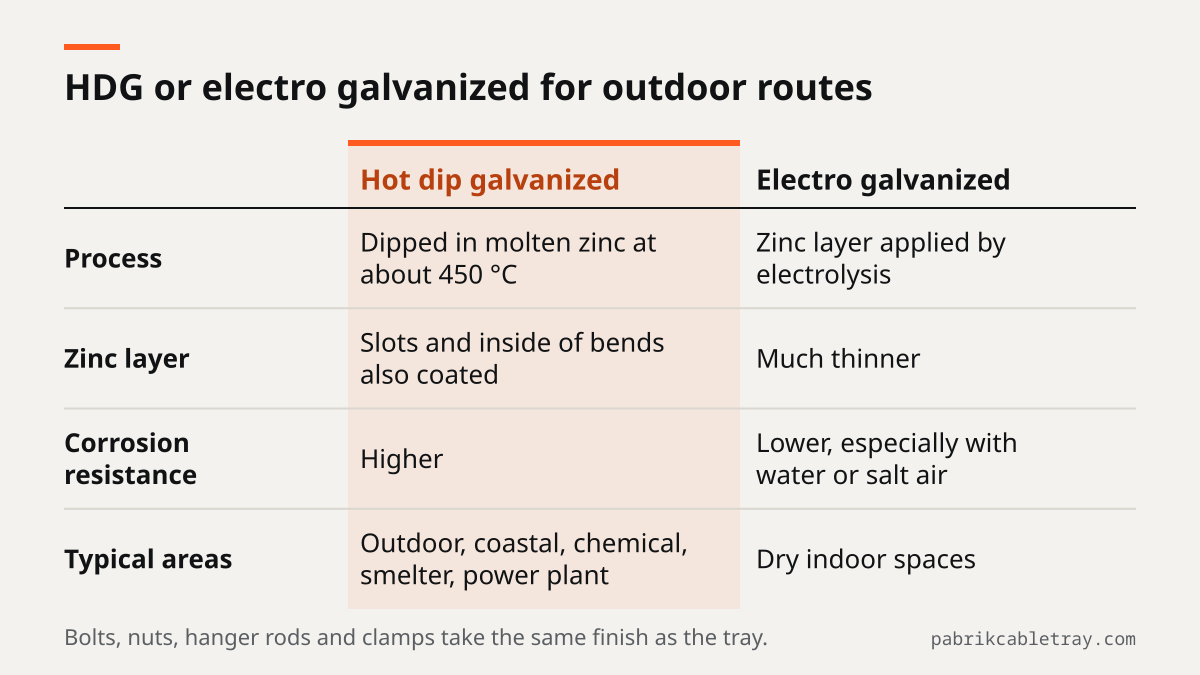
Electro galvanizing applies a much thinner zinc layer by electrolysis. Its corrosion resistance is lower, especially when exposed to water or salt-laden air, so this finish is intended for dry indoor spaces such as ceiling voids in office buildings, malls and panel rooms. Electro galvanized is not recommended for coastal areas. The full comparison of both processes is in the article HDG or electro galvanized.
Powder coating is an electrostatic powder paint that is oven cured, in RAL colors. The product data places it on fire alarm routes, data centers and architecturally exposed areas. For cable duct installed outdoors, the choice is HDG or outdoor grade powder coating.
Bolts and supports are HDG too
A common mistake on outdoor routes is HDG tray installed with electro galvanized bolts. The bolts rust first and stain the tray around them. For that reason, state in the BOQ that bolts, nuts, hanger rods and clamps have the same finish as the tray.
The 3/8 x 3/4 inch bolts are available in HDG or electro galvanized, and the finish of the accessories on the accessories page follows the tray finish. Writing HDG explicitly on the bolt line avoids mixed finishes when the material arrives on site.
Tray cut on site
A cut HDG edge loses its zinc protection. Apply zinc rich paint to every cut edge. List this paint as a separate item in the installation materials so it is not missed.
2. Covers: when to install them outdoors
Ponggawa's area data records three situations that use a top cover. Outdoor routes between plant buildings use HDG cable ladder with a top cover to protect it from heat and rain. On a pipe rack, a top cover is installed where cables are exposed to direct sun. Switchyards and outdoor routes also use HDG with a top cover.
A cover is not a single BOQ line. Every fitting needs its matching cover: straight, elbow, tee, cross, reducer and riser covers, plus cover clamps to fix the cover to the tray. The cover follows the tray finish, so on an outdoor route the cover is HDG as well.
The article when a cable tray needs a cover discusses cover size options for each tray width. Whether cables may be left open to the sun remains the decision of the project electrical designer, because it depends on the cable type used.
Cable duct for cables that must be fully enclosed
Where the route must be fully protected from dust, splashes, sunlight and mechanical damage, cable duct is an unperforated trough with a cover. For outdoor duct, add small drainage holes at the lowest point if water could be trapped. An enclosed duct dissipates cable heat less well, so the cable current rating needs to be corrected according to the installation standard.
3. Choosing tray or ladder for a pipe rack
On a pipe rack or open steel structure (gantry), the spacing between supports is set by the structural frames. That spacing may not be reducible just for the cable route. The system choice therefore starts from the available span, then the cable load.
System | When to use it on an outdoor route |
|---|---|
Dense power cables where hanger spacing cannot be reduced, for example on a pipe rack or over a service road | |
Long support spans, heavy medium voltage cables, outdoor routes carried by steel structures | |
Cable ladder type U | Where supports can be placed 2.5 to 3 m apart; this type is the most widely used for indoor and outdoor routes |
Perforated cable tray | Control, instrumentation and small to medium power cables that need a full base |
Type W uses double folded side rails, which raises the moment of inertia. The result is lower deflection at the same span than type U with an equal plate thickness. Heavy duty uses 127 or 152 mm lipped C rails, or 100 and 150 mm channel rails, for deeper cable fill and added stiffness.
As a capacity reference, an independent laboratory tested a cable ladder type W, 1,000 mm wide, 100 mm high, with 2.0 mm plate, made by Ponggawa's partner manufacturer in Bekasi. At a 2.5 m span, the ladder carried 360 kg at the 10 mm deflection limit (1/250 of the span, NEMA VE 1 class 10A), and the sample carried up to 550 kg per span. How to read these figures is explained in the article cable ladder load capacity.
That test result applies to one configuration. Capacity at other widths, rail heights, plate thicknesses and spans has to be calculated from your project data.
4. Supports on a pipe rack: check steps
On a pipe rack, the frame beams can serve as tray supports. Between frames, additional supports are made with brackets from the columns, or with hanger beams on M10 hanger rods from the structure above. The checks below help before shop drawings are prepared.
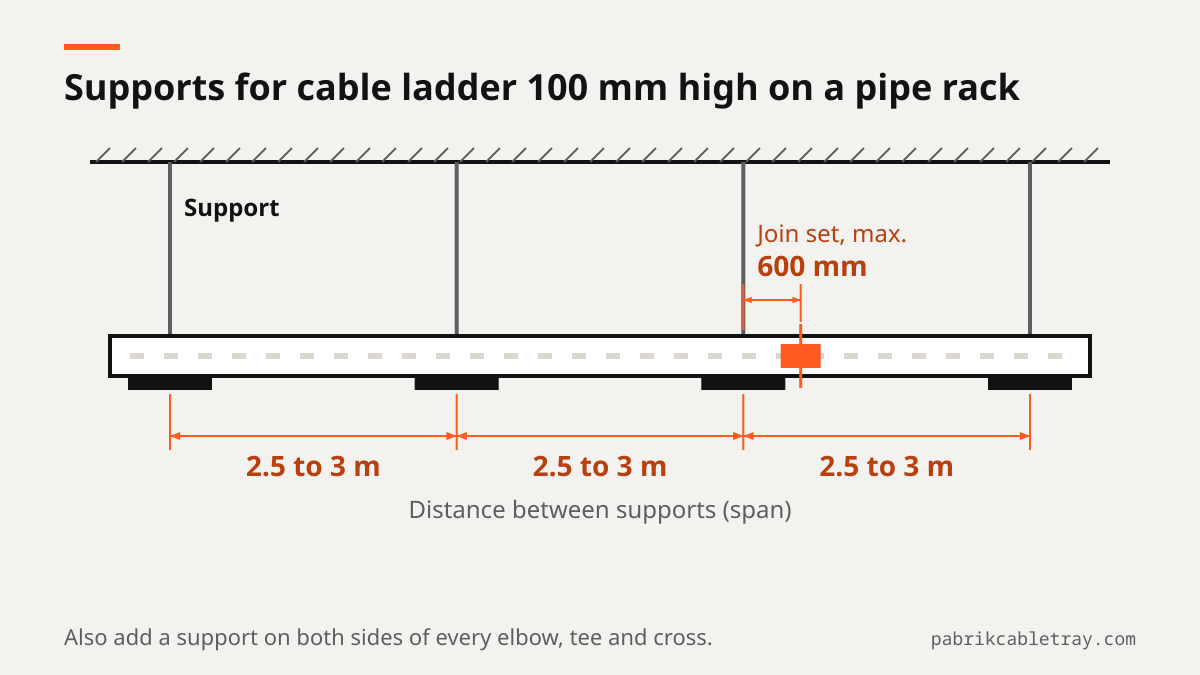
- Measure the span between frames. Compare it with typical support spacing: 2.5 to 3 m for cable ladder with a 100 mm height, and up to 3 m or more for heavy duty, subject to calculation. Details per system are in the article cable tray support spacing.
- Choose the system for that span. If the span cannot be shortened, increase the rail height or use type W or heavy duty rather than adding supports outside the structure.
- Mark the joint positions. With a standard length of 3,000 mm per piece, join sets fall at fixed points. Make sure there is a support within 600 mm of every join set; if a joint falls in the middle of a frame span, add a support near it.
- Add supports at every fitting. Install supports on both sides of each elbow, tee and cross.
- Fix the tray to the supports. Install a hold down clamp at every support so the tray does not shift off the beam.
- Plan the vertical runs. To go up or down from the pipe rack, use an inside or outside riser, install supports every 1.5 to 2 m, and tie the cables to the rungs with clamps every 300 to 600 mm.
- Match the finish. Brackets, hanger beams, hanger rods, clamps and bolts are HDG, like the tray.
For changes of angle that standard fittings cannot handle, fish plates and adjustable vertical or horizontal joints are available as angled connections.
5. Example situations in industrial estates
In Bekasi and Cikarang, estates such as Jababeka, MM2100 and EJIP host automotive and electronics plants and data centers. Ponggawa's area data for this corridor records HDG for production and outdoor areas, and powder coating for data centers. Routes that leave a building toward utilities or another building count as outdoor and follow the checklist above.
In the Serang and Cilegon corridor, cable routes usually run on open pipe racks exposed to heat, rain and chemical vapor. For this environment, the area data specifies cable ladder heavy duty 127 or 152 mm or type W, HDG finish, with a top cover where cables are exposed to direct sun.
Request a quotation for an outdoor route
Send the pipe rack layout drawing, BOQ or cable schedule to the Ponggawa team via the contact page. State the spacing between frames, HDG finish for the tray and all accessories, the route length that needs covers, and the project site address. From that data we work out the system, the number of supports and fittings, and prepare a quotation with the delivery schedule.
Frequently asked questions
Is electro galvanized good enough for outdoor cable tray?
It is not recommended. The zinc layer of electro galvanizing is much thinner and its corrosion resistance is lower, especially when exposed to water or salt-laden air. For outdoor use, specify hot dip galvanized and make sure bolts, nuts, hanger rods and clamps are HDG as well.
Does outdoor cable tray need a cover?
A top cover is installed where cables are exposed to direct sun or rain, for example on routes between plant buildings and on open pipe racks. Every fitting on that route needs its matching fitting cover and cover clamps. The project electrical designer decides whether the cable type used may be left open.
How should cable ladder be supported on a pipe rack?
The pipe rack frame beams can serve as supports, and the tray is fixed to every support with a hold down clamp. Add a support within 600 mm of every join set and on both sides of every fitting. If the spacing between frames cannot be reduced, choose cable ladder type W or heavy duty.
What if HDG tray has to be cut on site?
A cut edge loses its zinc protection. Apply zinc rich paint to that edge right after cutting, and include the paint in the installation materials list.
What span can a cable ladder carry on a pipe rack?
Typical support spacing for cable ladder with a 100 mm height is 2.5 to 3 m, and up to 3 m or more for heavy duty, subject to calculation. As a reference, a cable ladder type W 1,000 x 100 mm with 2.0 mm plate carried 360 kg at the 10 mm deflection limit at a 2.5 m span. Send your frame spacing and cable schedule so the capacity of other configurations can be calculated.