
Article · 2 November 2026 · 9 min read
Cable ladder load class and span: what to specify for a new plant
Fix the support span the structure allows, pick the NEMA VE 1 load class that covers the cable load at that span, and ask for a load test report that states its span and deflection limit.
Written by the Ponggawa technical team
Also available in: 简体中文
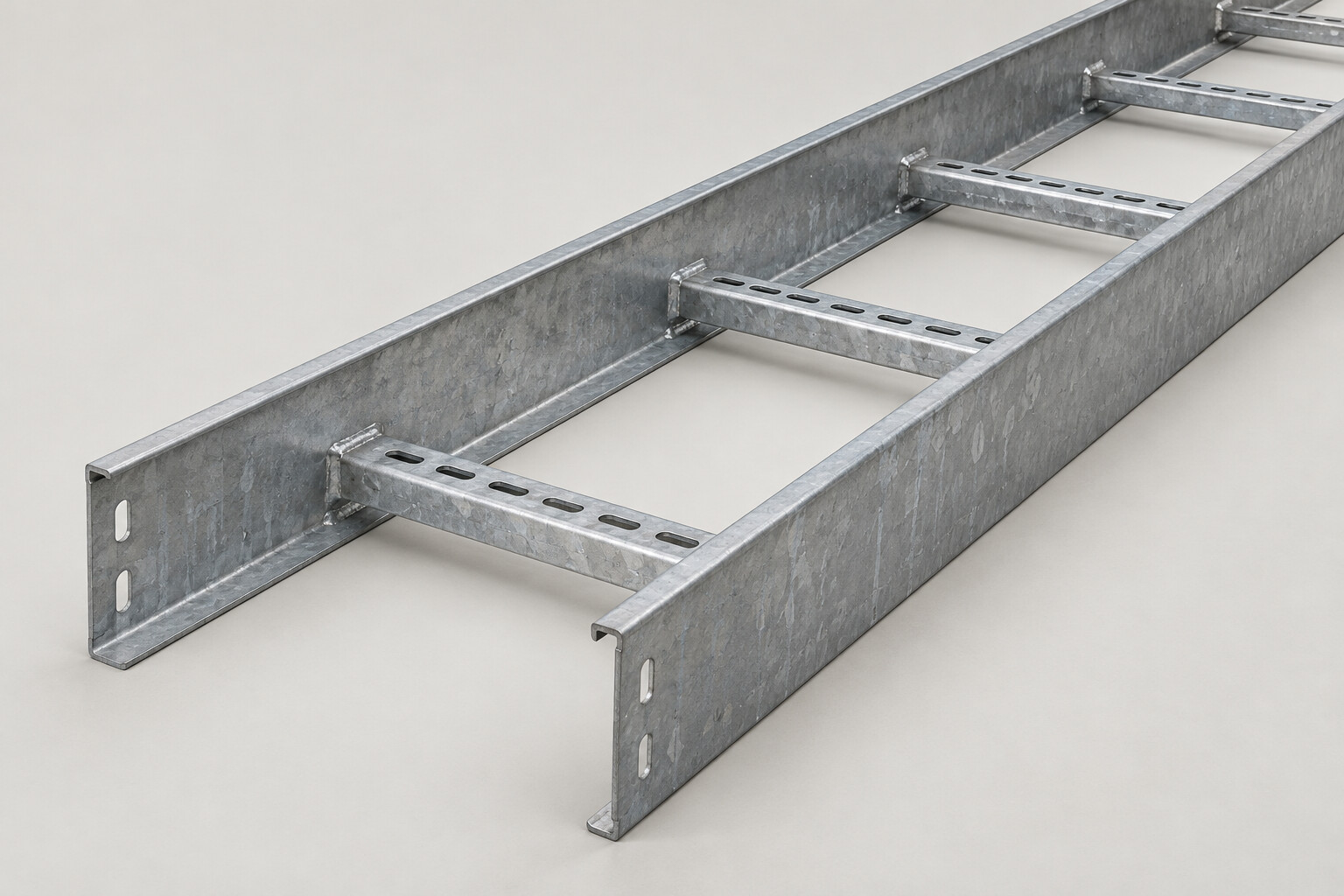
Short answer: Specify the cable ladder load class and the support span together, never one without the other. Fix the span the steel structure allows for each route, then choose the NEMA VE 1 load class that covers the cable load per meter at that span. Ask the supplier for a load test report that states the tested width, rail height, plate thickness, span and deflection limit.
How a NEMA VE 1 load class links span and load
NEMA VE 1 is the standard of the National Electrical Manufacturers Association for metal cable tray systems. It sets the load test method, the deflection limit and the load classes, which combine a support span with a working load per unit length. Specifications for projects in Indonesia often reference NEMA VE 1 together with IEC 61537.
In a class such as 10A, 12B or 20C, the number gives the support span in feet and the letter gives the working load category. Class 10A means a span of 10 feet (about 3 m) with load category A. A higher number or a higher letter calls for more capacity from the ladder.
The test itself is simple to picture. The ladder sits on supports at a set span, carries a uniform load, and its deflection is measured. The deflection at working load must stay inside the limit, and the ladder must carry several times the working load before it fails. For a full walk through the standard, read NEMA VE 1 for cable tray and cable ladder.
Choosing a load class for each power route
Routes in one plant can need different load classes, because the cable load and the support span change from route to route. Work route by route.
- Take the cable load per meter from the cable schedule. Add the cables that the designer expects to be added later. The project electrical designer decides the spare allowance.
- Fix the support span the structure allows. On a pipe rack or a steel structure, the span can follow the frame spacing. In a building, it follows the hanger points the ceiling or slab can take.
- Choose the class whose span and load category cover both numbers. If the site span is longer than the class span, move to a class with a longer span or reduce the span.
- Choose the ladder section that meets that class. Type, rail height, width and plate thickness all change capacity. Confirm the section with the supplier's test evidence, not with a catalogue description.
- Write the class, the span and the section into the BOQ line. A supplier can then quote one defined item instead of guessing.
Keep the design span and the class on the same drawing or schedule. When they sit in different documents, they drift apart during design changes.
Typical support spans for cable ladder and cable tray
The spans below are common rules of thumb. The final span depends on cable weight and plate thickness, so treat the table as a starting point for the load class check, not as a replacement for it.
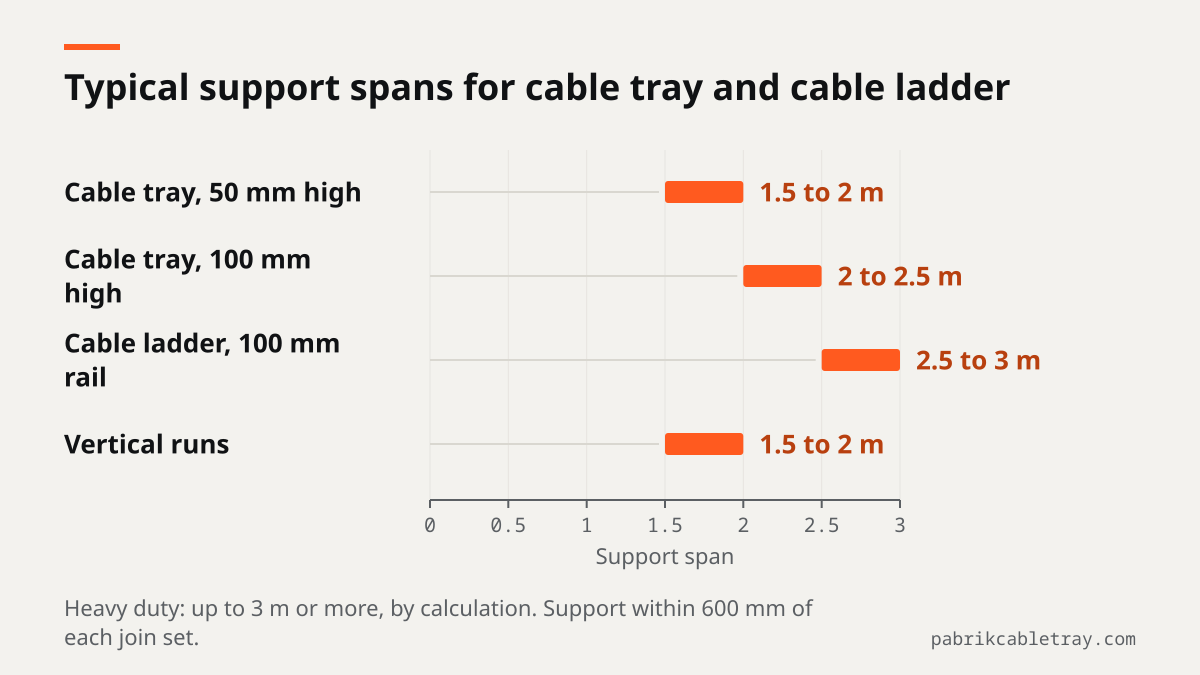
System | Typical support span |
|---|---|
Cable tray, 50 mm high | 1.5 to 2 m |
Cable tray, 100 mm high | 2 to 2.5 m |
Cable ladder, 100 mm rail | 2.5 to 3 m |
Cable ladder heavy duty | Up to 3 m or more, by calculation |
Three placement rules apply on top of the straight run span:
- Place a support within 600 mm of every join set.
- Place a support on both sides of every elbow, tee and cross.
- On vertical runs, support every 1.5 to 2 m and tie the cables to the rungs.
Because the standard length is 3,000 mm, joints fall every 3 m along a straight run. A route designed at a 2.5 m span therefore needs extra support points wherever a joint falls more than 600 mm from the nearest support. Count those extra points separately in the BOQ. More detail is in cable tray support spacing.
Does a longer span change the load class?
Yes. Deflection rises very quickly as the span grows. A span that is too long makes the ladder sag, makes the joints work as hinges, and puts strain on the cables inside.
The deflection limit in common use is 1/250 of the span, for example 10 mm on a 2.5 m span. A rating proven at one span does not carry over to a longer span. If the structure forces a longer span on a route, the specification needs a class with a longer span, a stiffer section, or both.
The same logic applies when a design tries to save supports. To use fewer supports, raise the rail height or use a stiffer ladder, rather than simply widening the hanger spacing.
Type W or heavy duty when the span cannot shrink
When the support span is fixed by the structure, change the ladder rather than the span.
- [Cable ladder type W](/en/products/cable-ladder/type-w) has a W profile side rail with an extra fold. This raises the moment of inertia, so type W deflects less on the same span than type U with an equal plate thickness. Type W comes in 75 and 100 mm rail heights and widths from 100 to 1,200 mm. It suits pipe racks, power plants and dense cable routes where the hanger spacing cannot be reduced.
- [Cable ladder heavy duty](/en/products/cable-ladder/heavy-duty) is designed for long support spans and heavy medium voltage cable loads. It uses a lipped C rail of 127 or 152 mm, or a channel rail of 100 or 150 mm. It is common on smelters, power plants, oil and gas and outdoor routes carried by steel structures.
The difference between the two rail profiles of the standard ladder is explained in cable ladder type W vs type U. Plate thickness is the other lever: Ponggawa supplies SPHC steel plate of 1.8 to 2.0 mm, with other thicknesses to order, as covered in cable tray and cable ladder plate thickness.
What test evidence to ask the supplier for
A load class on a datasheet is a claim. A test report is evidence you can check against your design span. Ask for these items with the quotation:
- The tested configuration: type, width, rail height and plate thickness of the sample.
- The test span: the support span used in the test.
- The deflection limit and the load at that limit: the figure your design depends on.
- The highest load the sample carried: this shows the margin beyond the working load.
- Who ran the test and who made the sample: these are two different roles and the report should show both.
- The quality system of the maker: the manufacturing side, separate from the test.
Here is what that looks like for the evidence Ponggawa can show. The partner manufacturer in Bekasi, which holds ISO 9001:2015, made a type W cable ladder 1,000 mm wide with a 100 mm rail and 2.0 mm plate. An independent laboratory tested it on a 2.5 m span. The laboratory recorded 360 kg at the 10 mm deflection limit (1/250 of the span, NEMA VE 1 class 10A), and the sample carried up to 550 kg per span. The figures and how to read them are in cable ladder load capacity.
That report covers one configuration. Capacity for another width, rail height, plate thickness or span depends on those values, so ask for a calculation for your own routes rather than reading one result across every size. When a report gives both a figure at a span and a class, ask the supplier to confirm which span each refers to and compare it with your design span.
A specification line a supplier can quote
A specification that a supplier can price without questions names the product, the section, the finish, the class and the span in one line. For example:
Field | Example entry |
|---|---|
Product | Cable ladder type W |
Width x rail height | 1,000 x 100 mm |
Material and plate | SPHC, 2.0 mm |
Length | 3,000 mm standard |
Finish | Hot dip galvanized (BS 729, DIN 50976) |
Design reference | NEMA VE 1, load class as calculated for the route |
Support span | Design span per route, plus a support within 600 mm of each join set and on both sides of each fitting |
Evidence | Load test report for the tested configuration, calculation for other sizes |
Hot dip galvanized is the standard choice for outdoor, coastal and heavy industry routes such as smelters and power plants. If the route is indoors and dry, the finish line changes, but the class and span lines stay.
Send your drawings, BOQ or cable schedule, with the design span and the required load class for each route, through the contact page. Ponggawa prepares a quotation per project, coordinates production with the partner manufacturer and delivers to sites across Indonesia. Ask for the delivery schedule to be written in the quotation.
Frequently asked questions
How do I choose between load classes?
Start with the cable load per meter from the cable schedule and the support span the structure allows. Pick the class whose span and load category cover both, then confirm the ladder section against test evidence. Choose per route, because cable load and span can differ from one route to the next.
Does a longer span change the class?
Yes. Deflection rises very quickly as the span grows, so a rating proven at one span does not apply to a longer one. Either move to a class with a longer span, use a stiffer ladder such as type W or heavy duty, or reduce the span.
What test evidence should the supplier provide?
Ask for a load test report that states the tested width, rail height, plate thickness, span, deflection limit, the load at that limit and the highest load the sample carried. The report should show who tested the sample and who made it. For sizes and spans outside the tested configuration, ask for a calculation.
Can one test report cover every cable ladder size on the project?
No. A report covers the configuration that was tested, for example a type W ladder 1,000 mm wide with a 100 mm rail and 2.0 mm plate on a 2.5 m span. Capacity changes with width, rail height, plate thickness and span, so other sizes need their own check.
Where do I write the load class in the BOQ?
Put the load class and the design span on the same line as the product, size, plate thickness and finish. That way the supplier quotes a defined item and the class does not drift away from the span during design changes.