Article · 24 October 2026 · 8 min read
What an Indonesian supplier needs to quote your cable tray BOQ
Send route drawings or a cable tray BOQ with system type, width, height, plate thickness, finish, fittings and support details, plus the delivery site, so the quotation is complete.
Written by the Ponggawa technical team
Also available in: 简体中文
Short answer: To quote a cable tray BOQ completely, an Indonesian supplier needs the route layout or BOQ, the system type per route, width and height, plate thickness, finish, the fitting count, the support and accessory scope, and the delivery site. With those items, every line can be priced and checked. Missing any of them turns the quotation into an assumption that you will have to correct later.
Why a cable tray BOQ often comes back incomplete
A BOQ line such as "cable tray 300 x 100, 600 m" can be quoted, but it leaves out much of what goes on site: the fittings at every bend, the join sets, the hangers and the clamps. Those items then come back as additions after the order.
A complete enquiry lets the supplier count every component from your layout. At Ponggawa, straight lengths, fittings, supports, hold-down clamps and bolts are counted together from your BOQ or layout, so the quotation reflects a route that can actually be installed.
The checklist: what to send with your enquiry
Use this table as a cover sheet for your RFQ. Each row is something that changes the scope or the cost of the quotation.
Item | What to state | Why it matters |
|---|---|---|
Drawings | Cable route layout in plan and section, with elevations | Lets the supplier count fittings, risers and supports |
BOQ or cable schedule | Lengths per size, or cable diameters and quantities per route | Defines straight lengths, or lets the tray size be checked |
System type | Cable ladder, perforated cable tray, cable duct, raceway or wire mesh tray | Each system has its own profile and fittings |
Profile | Type U, type W or heavy duty for ladder; type U or type C for tray | Changes stiffness, and with it the support span you can use |
Width and height | For example 300 x 100 mm, per route | The main size of every straight and fitting |
Plate thickness | 1.8 mm, 2.0 mm or another thickness to order | Drives weight, stiffness and cost |
Finish | Hot dip galvanized, electro galvanized or powder coating (with RAL code) | Depends on the environment of each route |
Fittings | Count of elbows, tees, crosses, reducers and risers, radius or diagonal | Not visible in a lengths-only BOQ |
Supports | Hanger beam with hanger rod, or bracket, and the intended spacing | Determines the support count |
Accessories | Covers, cover clamps, separators, end plates, hold-down clamps | Easy to forget, needed for handover |
Delivery | Project site location and any phasing | Delivery cost is quoted to the site |
How to describe each item so it can be quoted
System and profile per route
State the system per route, not once for the whole project. A plant can combine cable ladder for main power routes and perforated tray for control and instrument cables. If your design uses a stiffer profile for long spans, name it: the cable ladder range includes type U, type W and heavy duty rails.
For perforated tray, the type U and type C profiles share the same join set and bolts, so both can be combined in one project. Say which one each route uses, or ask the supplier to propose one based on width.
Width, height and length
Give width and height in millimetres, as in the drawing. Cable tray is available from 100 to 1,000 mm wide in 50 and 100 mm heights. Cable ladder runs from 100 to 1,200 mm wide, with rail heights of 50, 75, 100, 127, 150 and 152 mm.
The standard length is 3,000 mm per piece. Give route lengths in metres and the supplier converts them to pieces. If you only have a cable schedule, the width can be calculated from cable diameters and a fill ratio; see how to size a cable tray from the number of cables.
Material, plate thickness and design standard
The products are made of hot rolled sheet steel SPHC with a 1.8 to 2.0 mm plate, and other thicknesses can be made to order. Design follows NEMA VE 1 for cable tray and cable ladder.
If your specification is written to IEC 61537 or to a company standard, quote the clause and the required load and span in the enquiry. The quotation can then state plainly how the offer relates to it, and your engineer can decide. For a verifiable reference point, an independent laboratory tested a type W cable ladder made by the partner manufacturer in Bekasi. At 1,000 mm wide, 100 mm high, with 2.0 mm plate on a 2.5 m span, it carried 360 kg at the 10 mm deflection limit (1/250 of the span, NEMA VE 1 class 10A), and the sample carried up to 550 kg per span.
Finish per environment
The finish options are hot dip galvanized (BS 729, DIN 50976), electro galvanized and powder coating. Hot dip galvanized is the usual choice for outdoor, coastal, chemical and heavy industry areas. Electro galvanized suits dry indoor areas such as offices and panel rooms. Powder coating is used where a colour code identifies the route, for example fire alarm routes.
If a project has both indoor and outdoor routes, split the BOQ lines by finish. The finish comparison explains the difference in more detail.
Fittings
List every fitting by type and size: horizontal elbow, tee, cross, reducer (center, left hand or right hand) and inside or outside riser. State whether you want radius or diagonal models. When the route has bends that are not 90 degrees, adjustable vertical and horizontal pieces or fish plates are used instead.
If you cannot count fittings yourself, send the layout and ask the supplier to count them. That is a normal request.
Supports and accessories
Supports are counted per point along every route. State whether routes hang from the structure (hanger beam with M10 hanger rod) or sit on brackets from walls or columns, and give the support spacing from your design.
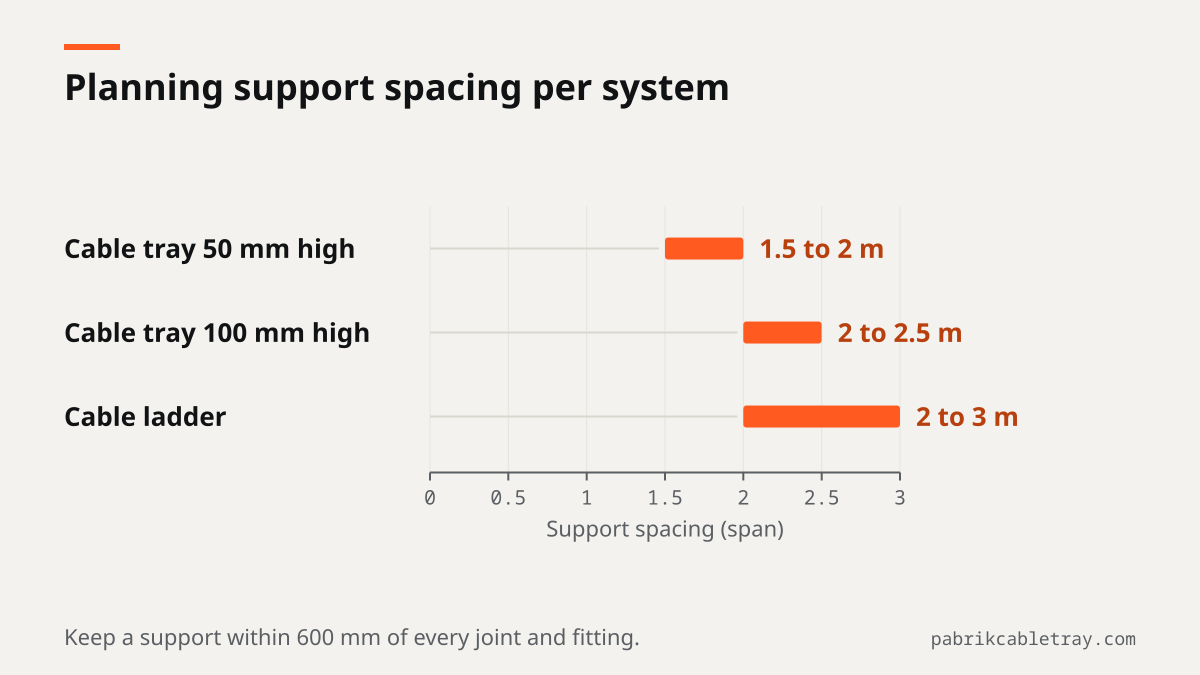
As a planning guide, perforated tray 50 mm high is usually supported every 1.5 to 2 m, tray 100 mm high every 2 to 2.5 m, and cable ladder at spans of 2 to 3 m, with a support within 600 mm of every joint and fitting. Your final spacing depends on the cable load; see cable tray support spacing.
Then list the accessories: join sets, hold-down clamps, covers and cover clamps, straight separators and end plates. The accessories guide describes what each part does.
A worked count for one straight route
Here is how a supplier turns one BOQ line into components. Take a straight route of 30 m, built from 3 m pieces, with supports every 2 m.
- Straight pieces: 30 m divided by 3 m gives 10 pieces.
- Join sets: one per joint between pieces, so 9 join sets.
- Support points: every 2 m along 30 m gives 16 points.
- Per support point: 1 hanger beam, 2 hanger rods and 2 hold-down clamps.
- Add fittings, covers and the joints at every fitting from the layout.
Multiply this across every route and the gap between "600 m of tray" and a complete BOQ becomes clear. Grounding and bonding items also belong in the BOQ; see cable tray grounding and bonding.
Which items drive the cost of the quotation
Prices on a cable tray quotation move with a small set of variables. Knowing them helps you compare offers line by line.
- Width and height: larger sections use more steel per piece.
- Plate thickness: a thicker plate adds weight and cost.
- Finish: hot dip galvanized, electro galvanized and powder coating are priced differently.
- Fittings count: every bend, branch and level change adds a fitting.
- Quantity: the total volume of the order.
- Delivery: the distance and route to the project site.
What to confirm in the quotation you receive
A quotation from Ponggawa states the price per component, with VAT and the delivery cost to the project site written separately. Plate thickness, finish and the reference standard are written on the quotation, so the goods can be checked when they arrive on site.
Before you award, check these points:
- Every route, size and finish in your BOQ appears as its own line.
- Fittings, supports, clamps and bolts are included, not only straight lengths.
- Covers are priced separately from the straight pieces, where you need them.
- Plate thickness and finish match your specification.
- The delivery schedule and the delivery address are stated; ask for the schedule in the quotation.
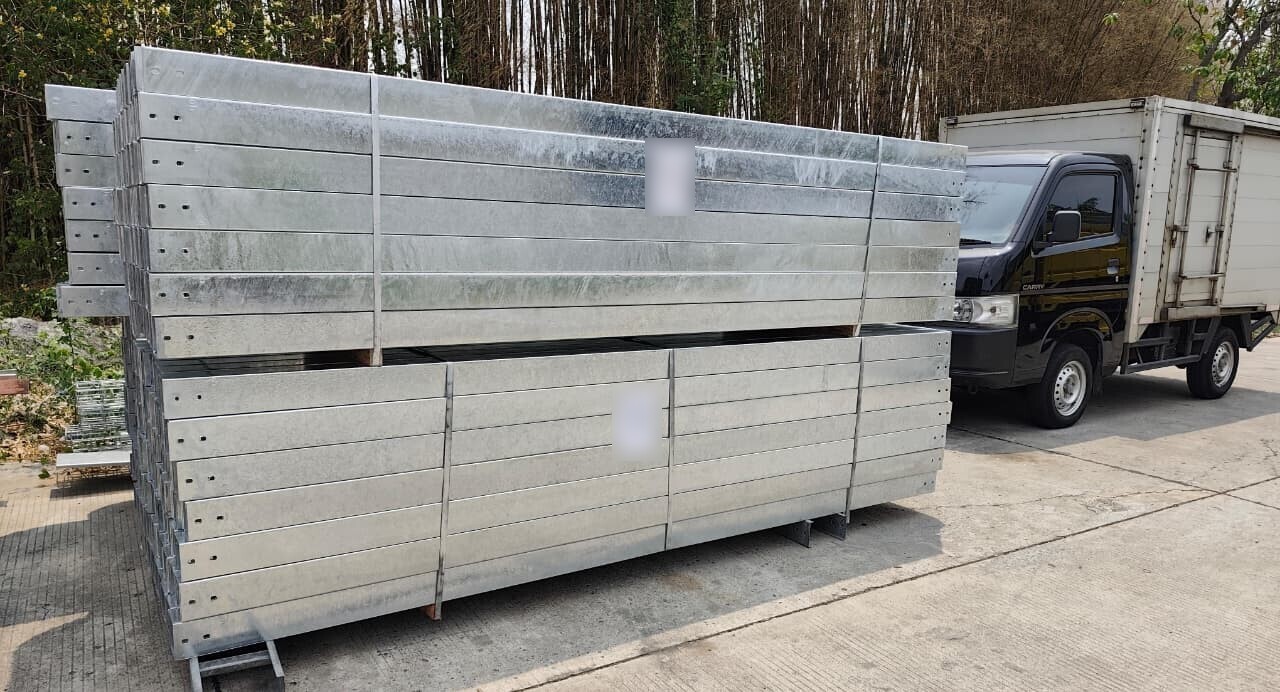
Goods are bundled per size and shipped from Bekasi, by truck within Java and by sea freight outside Java. Read more about how orders are handled on the about page.
Send your BOQ for a quotation
If your team is preparing an RFQ for a plant, data center or smelter in Indonesia, send the drawings, the BOQ or the cable schedule through the contact page. The more of the checklist above you include, the closer the quotation comes to the full route. You can also browse the product range to match your BOQ lines to the available systems.
Frequently asked questions
Can you quote from drawings alone?
Yes. A quotation can be prepared from route drawings, a BOQ or a cable list. From a layout, the supplier counts straight pieces, fittings, supports and clamps. State the system, finish and plate thickness on the drawing or in the enquiry so these are not assumed.
Which items drive the cost of a cable tray quotation?
The main drivers are width and height, plate thickness, finish, the number of fittings, the total quantity and delivery to the site. A BOQ that lists only straight lengths leaves fittings and supports out. Comparing offers line by line on these items shows where they differ.
What should be confirmed in the quotation?
Check that every route and size has its own line, that fittings, supports and accessories are included, and that plate thickness, finish and the reference standard are written down. Confirm that VAT and delivery cost are shown separately. Ask for the delivery schedule to be stated in the quotation.
Do you need a cable schedule if the BOQ already lists tray sizes?
Not to quote. A BOQ with sizes and lengths is enough to price the material. A cable schedule helps when you want the tray width checked against cable diameters and quantities before you order.
Can one quotation cover cable ladder, cable tray and accessories together?
Yes. Ponggawa supplies cable ladder, cable tray, cable duct, raceway and wire mesh tray together with the fittings, covers and supports to install them. One BOQ can cover all of them, split by route, size and finish.