Comparisons · 23 October 2026 · 7 min read
Wire mesh or perforated cable tray: which one suits your cables
Choose wire mesh for light data, fiber and control cables on routes that change often. Choose perforated cable tray for small to medium power cables and routes that need a cover.
Written by the Ponggawa technical team
Also available in: Bahasa Indonesia · 简体中文
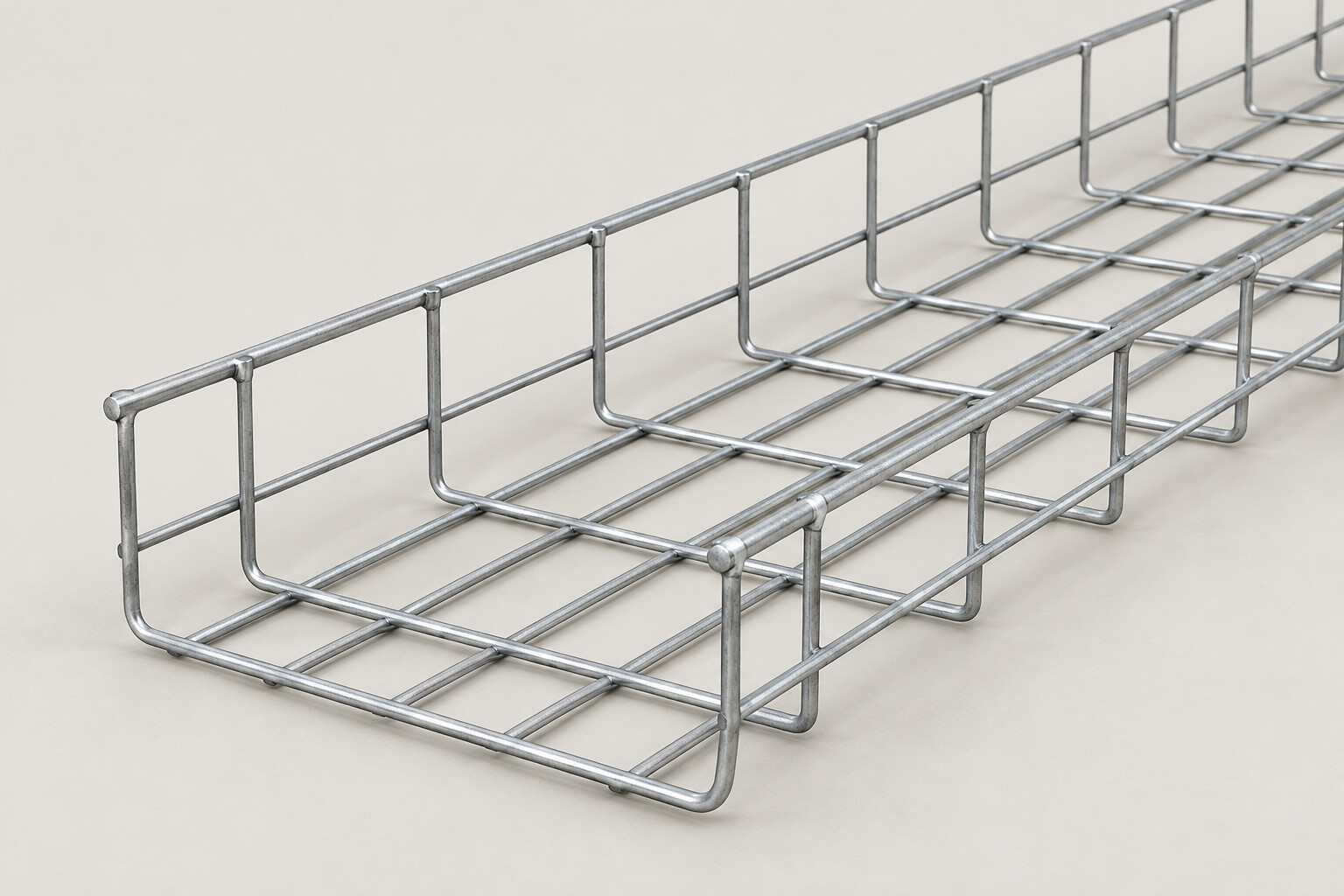
Short answer: wire mesh cable tray is a light welded steel wire basket that can be cut and bent on site, suited to data, fiber and control cables. Perforated cable tray is a steel sheet trough with a continuous slotted base, suited to control, instrumentation and small to medium power cables. For heavy power cables and long support spans, specify sheet steel cable tray or cable ladder rather than wire mesh.
Two systems that support cables in different ways
Wire mesh cable tray, often called basket tray, is made from steel wire welded into a 50 x 100 mm grid and then bent into a U profile. The wire ends along the top edge have a safe T weld finish so they do not injure cables or installers during cable pulling.
Perforated cable tray is made from hot rolled SPHC steel sheet, 1.8 to 2.0 mm thick, bent into a U or C profile. The base is filled with rows of oval slots, so the cables are supported along the whole route and can be tied down at any point.
This difference drives almost everything else in the specification: the load each system suits, how sections are joined, how bends are made and how the BOQ is built up.
Side-by-side comparison
Aspect | Wire mesh (basket tray) | Perforated cable tray |
|---|---|---|
Material | Welded steel wire, 50 x 100 mm grid | SPHC steel sheet, 1.8 to 2.0 mm |
Profile | U-profile basket | Trough (type U or type C) |
Width | 100 to 600 mm | 100 to 1,000 mm |
Height | 50 and 100 mm | 50 and 100 mm |
Suitable cables | Data, fiber, control | Control, instrumentation, small to medium power |
Bends and branches | Wires cut on site, joined with clamps | Prefabricated fittings (elbow, tee, cross, reducer, riser) |
Section joints | Splice and clamp joints | Join set with bolts (3/8 inch or M8) |
Finish | Electro zinc or HDG | HDG, electro galvanized, powder coating |
For sizes outside this list, send your requirements and we check availability when we prepare the quotation.
Load: is wire mesh strong enough for power cables
For data cables and other light cables, wire mesh is more than sufficient. The basket itself is light, which makes it easy to install in office building ceilings or above server room racks.
For heavy power cables and long spans, choose sheet steel cable tray or cable ladder. Large-diameter power cables still belong on cable ladder.
If the choice falls on sheet steel cable tray, look at the profile. For trays 400 mm wide and above, or for longer support spans, type C cable tray gives a stiffer top edge that does not bend easily when cables are pulled.
The capacity of any route depends on width, height and support spacing. If your route carries a mix of data and power cables, send the cable list and the planned support spacing, and our team helps you choose the system.
Installation: joints, hangers and bends
Wire mesh
Wire mesh sections are joined with splice and clamp joints. The basket is hung with hangers or center supports from the ceiling or from racks. Dividers can be installed inside the basket to separate cable groups.
Its main advantage is how easily the route can change. Bends, tees and reducers are made by cutting a few wires and joining the basket with clamps, with no wait for factory-made fittings. In data centers or server rooms where the rack layout shifts often, the site team can adjust the route on the spot.
Perforated cable tray
Standard 3,000 mm tray lengths are joined with join sets and bolts. Bends and branches use prefabricated fittings: elbow, tee, cross, reducer and inside or outside riser, in radius or diagonal models. Hold-down clamps lock the tray to its supports.
Cable tray support spacing is typically 1.5 to 2 m for 50 mm high tray and 2 to 2.5 m for 100 mm high tray, depending on the cable load. Place a support within 600 mm of each joint and of every fitting. The full explanation is in our article on cable tray support spacing.
Because the fittings are ordered to match the drawings, the cable tray route should be final before the order is placed.
Finish and environment
Wire mesh is available in electro zinc or HDG. Perforated cable tray is available in hot dip galvanized (BS 729, DIN 50976), electro galvanized and powder coating.
Choose the finish from the installation environment. Electro galvanized suits dry indoor areas such as office buildings, malls and panel rooms. HDG is the standard choice for outdoor, humid, coastal and heavy industrial areas. Powder coating is used when the color of the route matters, for example red or orange for fire alarm routes. The detailed comparison is in our article on hot dip galvanized vs electro galvanized.
For routes that must be covered, perforated cable tray has covers for straight sections and for every fitting, locked with cover clamps. For wire mesh, ask about covers when you request a quotation.
How to choose in four steps
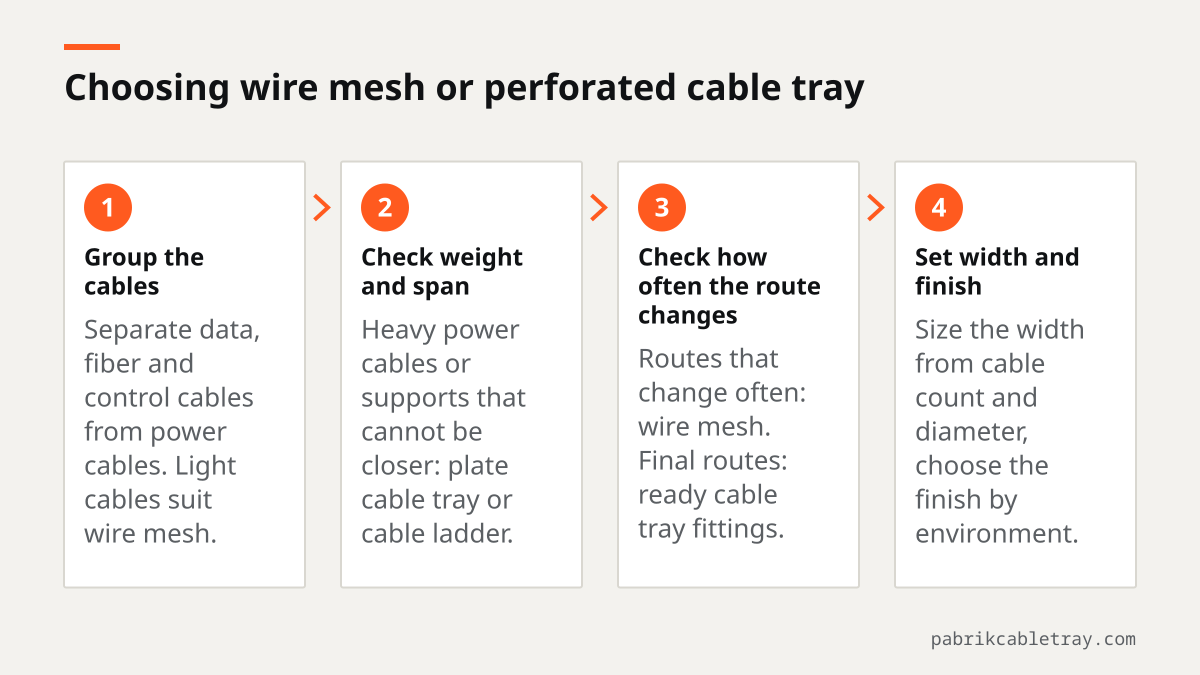
- Group the cables. Separate data, fiber and control cables from power cables. The light cable groups are candidates for wire mesh.
- Check weight and span. Heavy power cables, or supports that cannot be placed closer together, point to sheet steel cable tray or cable ladder.
- Consider how often the route changes. Routes that are adjusted on site often are easier to build with wire mesh; routes that are already final suit prefabricated cable tray fittings.
- Set the width and finish. Work out the width from the number and diameter of the cables, as explained in our guide to cable tray sizing, then choose the finish from the installation environment.
One project can use both at once: cable tray or cable ladder for the power routes, and wire mesh for data cables above the racks or in the server room ceiling.
When cable ladder is a better choice than either
Choose cable ladder for large-diameter power cables, medium voltage cables, main routes and support spans of 2 to 3 m. A ladder consists of two side rails connected by rungs every 300 mm, so large cables can be tied directly to the rungs.
Small cables do not suit a ladder, because they sag between the rungs. For small cables on a power route, go back to perforated cable tray. Tray and ladder are compared in our article on cable tray vs cable ladder.
Request a quotation for both options
Send your layout drawings, BOQ or cable schedule through the contact page. State the cable groups, the planned support spacing and the installation environment. We prepare the wire mesh and cable tray quotations side by side, complete with joints, supports and fittings, so you can compare both options for the same project.
Frequently asked questions
Can wire mesh tray carry power cables?
Wire mesh is intended for light cables such as data, fiber and control, not for heavy power cables. Put the light cable groups on wire mesh, and place heavy power cables and routes with long spans on sheet steel cable tray or cable ladder. If the route carries mixed cables, send the cable list and support spacing so the right system can be chosen.
How is wire mesh tray joined and supported?
Wire mesh sections are joined with splice and clamp joints. The basket is hung with hangers or center supports from the ceiling or from racks. Bends, tees and reducers are made by cutting a few wires and joining the basket with clamps.
When should I specify cable ladder instead of wire mesh?
Cable ladder is a better choice for large-diameter power cables, medium voltage cables, main routes and support spans of 2 to 3 m. Wire mesh is intended for light data, fiber and control cables.
What wire mesh sizes are available?
Wire mesh is available in widths of 100, 150, 200, 300, 400, 500 and 600 mm, with a height of 50 or 100 mm. The wire grid is 50 x 100 mm. For routes wider than 600 mm, perforated cable tray is available up to 1,000 mm wide.
What drives the cost of wire mesh and cable tray?
Cost depends on width, height, finish, the number of joints and supports, the number of fittings and the order quantity. For cable tray, plate thickness and the number of prefabricated fittings also play a part. Send your BOQ or drawings so we can prepare a quotation for both options.